This post may contain affiliate links. As a Sheet Music Plus and Amazon Associate, I earn from qualifying purchases. That means I make a small commission (at no additional cost to you) if you purchase something from an affiliate link.
Learning to read music is an important part of piano lessons, but students also need to develop their listening skills. Ear training helps beginner piano students recognize musical patterns, hear differences in sound, and become more confident musicians.
Ear training does not need to be a separate lesson. Simple listening activities can easily be incorporated into each week’s piano lesson and only take a few minutes.
Why Is Ear Training Important?
Many beginners focus entirely on reading notes, but music is much more than what’s written on the page. Students who develop a good ear often:
- Learn pieces more quickly
- Play with greater musicality
- Recognize mistakes more easily
- Develop stronger rhythm skills
- Build confidence when learning new music
Even young beginners can begin developing these skills through fun games and activities.
What Ear Training Skills Should Beginners Learn?
For students ages 6–8, keep ear training simple.
Some of the first skills to introduce include:
- High vs. low sounds
- Loud vs. soft dynamics
- Fast vs. slow tempo
- Same vs. different
- Long vs. short sounds
- Simple melodic direction (up, down, or repeated)
These listening skills provide an excellent foundation before introducing more advanced concepts later.
1. High or Low?
One of the easiest ear training games is identifying whether a sound is high or low.
Play a note somewhere on the keyboard and ask:
“Was that high or low?”
As students improve, gradually increase the distance between notes or play several notes in succession.
Using animals such as a lion and a bird can help students compare sounds to a low lion roar or a high bird chirp.
2. Same or Different?
Play two short patterns.
Ask:
- Were they the same?
- Or were they different?
At first, change only one note. As students become more confident, increase the difficulty by changing rhythm or direction.
Students love trying to “catch” the different pattern.
3. Loud or Soft?
Ear training is a wonderful way to reinforce dynamics.
Play a short musical phrase using different dynamics and ask students to identify whether you played loud or soft. Students can practice using the terms piano for soft and forte for loud. This activity works especially well after students have already learned basic dynamic markings.
This type of exercise can also be used to practice legato and staccato. This is another great time to practice these terms. To learn more about helping students with terms, check out the blog post: Musical Terms & Symbols for Beginner Piano Students
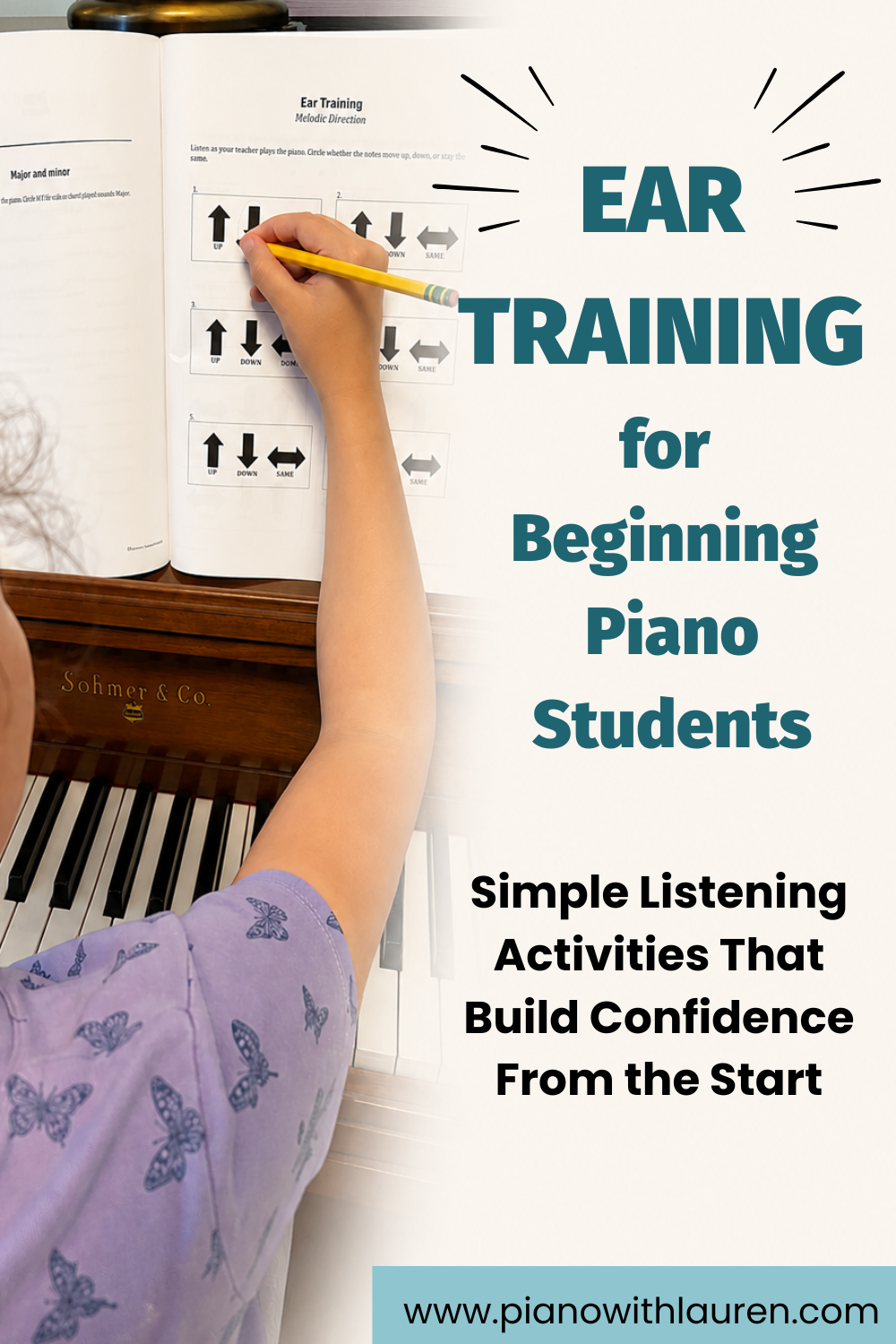
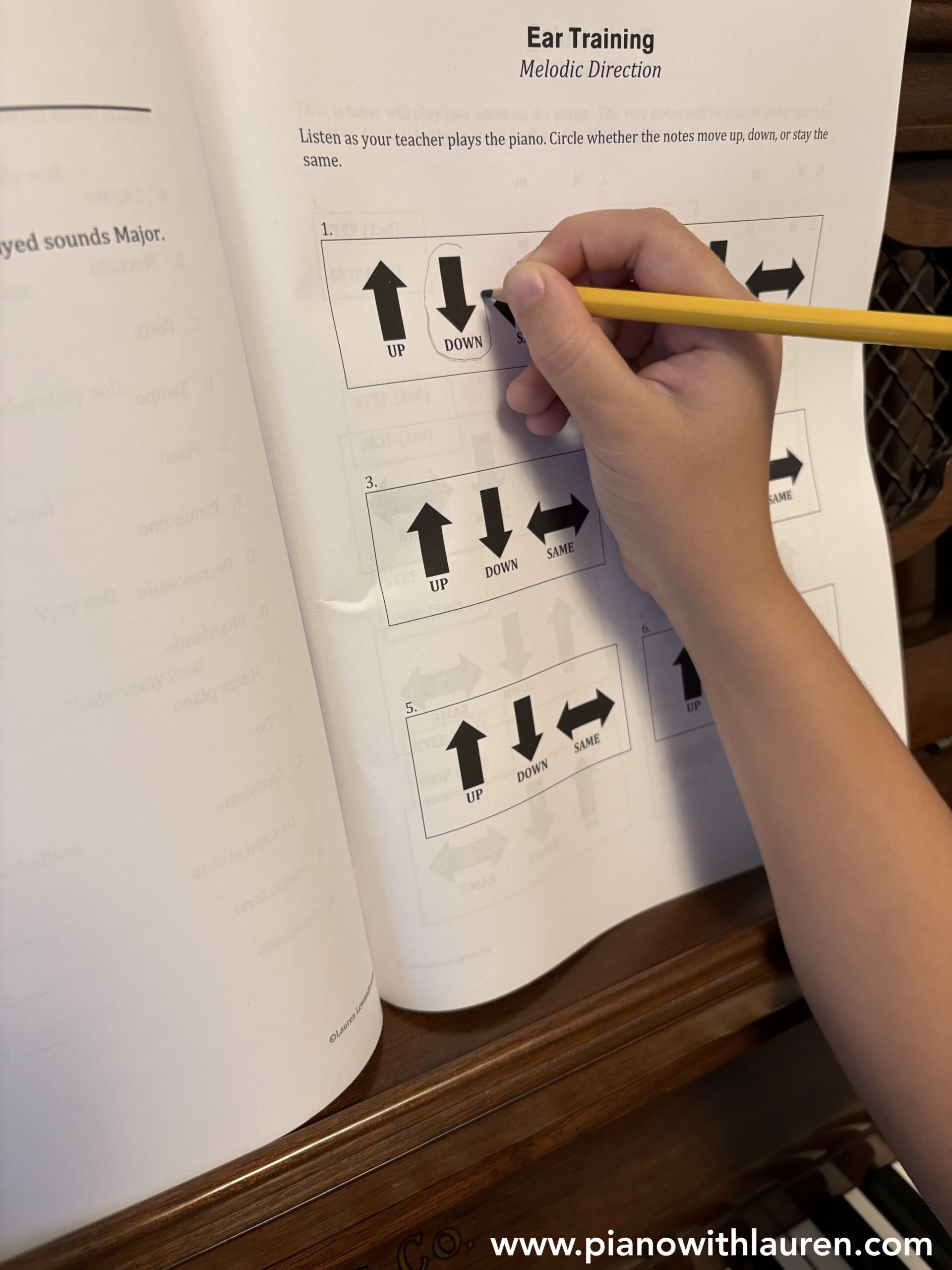
4. Up, Down, or Repeat?
Play three to five notes.
Ask students whether the melody:
- Went up
- Went down
- Stayed the same
This simple activity helps prepare students for reading melodic patterns on the staff.
Tips for Ear Training
⭐️ Ear training doesn’t need to become a separate lesson. Keep it simple by spending just a few minutes each week on a listening activity.
⭐️ Small amounts of consistent practice are far more effective than long ear training drills.
⭐️ Some teachers make paddles that say terms like “loud” or “soft” on them for the student to hold up their answer. This adds a tactile element to ear training for those students who need something to hold.
⭐️ Be patient. Listening skills develop over time.
Resources That Support Ear Training
➡️ Method Books
Many beginner method book series offer an ear training book to support learning. Series such as Alfred’s Basic Piano Library and Basiten offer these books.
➡️ Theory Book
Ear training topics are included in the Ready for Theory series. Check out Piano Workbook Prep A for some of the topics mentioned in this post.
➡️ Make Your Own
In this post, Joy Morin shows how she creates listening signs for ear training. You can create your own signs for students using wooden sticks and paper.
Ear training is one of the simplest ways to help beginner piano students become more confident musicians. By spending just a few minutes each lesson on listening games, students begin developing skills that will support everything else they learn.
The goal isn’t perfection—it’s helping students become active listeners who enjoy making music.
Continue Building Music Theory Skills
If you’re teaching beginner piano students ages 6–8, these guides cover the essential music theory concepts every student should learn.
- Piano Theory for Beginners: What Students Ages 6–8 Need to Learn
- Music Note Naming for Beginner Piano Students
- How to Teach Steps, Skips, and Intervals to Beginner Piano Students (Ages 6–8)
- Teaching Rhythm to Beginner Piano Students
- Major Five-Finger Scales & Chords for Beginner Piano Students
- Musical Terms & Symbols for Beginner Piano Students
- Ear Training for Beginner Piano Students
Ready to Put It All Together?
Most of my blog posts explore one teaching topic at a time. If you’re looking for a complete first-year teaching roadmap, my course, Beyond the Lesson Book, shows how these concepts fit together across an entire year of beginner piano lessons.
🎹 Explore Beyond the Lesson Book

Lauren teaches piano to students of all ages. She enjoys creating resources for her students and teachers. She is the author of Ready for Theory®. For personalized help, check out the consultations page for teachers.