This post may contain affiliate links. As a Sheet Music Plus and Amazon Associate, I earn from qualifying purchases. That means I make a small commission (at no additional cost to you) if you purchase something from an affiliate link.
As beginning piano students become more confident reading notes, rhythms, and intervals, they’re ready to learn the musical symbols that bring music to life.
Musical terms help students understand how a piece should sound—not just which notes to play. Even simple markings can encourage students to play with more expression and confidence.
For students ages 6–8, the goal isn’t memorizing dozens of Italian terms. Instead, introduce a small number of symbols naturally as they appear in music.
Why Musical Terms Matter
Many beginners focus so much on playing the correct notes that they forget music is meant to be expressive.
Learning musical symbols helps students:
- play with more expression
- develop good listening skills
- notice details in their music
- become more independent readers
Here are the musical terms and symbols every beginner should learn.
➡️ Dynamics
Dynamics tell us how loudly or softly to play.
The first dynamics most beginners learn are:
- p (piano) — play softly
- f (forte) — play loudly
Once students are comfortable with these, you can introduce:
- mp (mezzo piano) — moderately soft
- mf (mezzo forte) — moderately loud
There’s no need to introduce every dynamic marking during the first year. Focus on helping students hear the difference between soft and loud playing.
⭐ Teaching Tip: Sometimes it is hard for students to make a difference between piano, mezzo piano, and mezzo forte. when teaching dynamics, always emphasize that the listener needs to hear the difference between the dynamics. This will help students add more contrasts in their playing.
➡️ Articulations
Articulations tell students how to play the notes.
The two most important articulations for beginners are:
Legato
Legato means to play smoothly by connecting the notes together.
The notes need to connect without any break in sound.
When learning legato, students will also learn to recognize a slur.
Staccato
Staccato means to play the notes short and detached.
Help students push off the keys to get a short, crisp sound.
Teaching both articulations early helps students begin thinking about musical character instead of simply pressing keys.
➡️ Tempo Markings
Tempo tells us how fast or slow the music should be.
Many beginner books simply use words like:
- Fast
- Slow
- Moderate
As students become more comfortable, they’ll begin seeing common Italian terms such as:
- Allegro
- Andante
The important skill is learning to recognize that every piece has an appropriate speed.
➡️ Repeat Signs
One of the first symbols students encounter is the repeat sign.
Rather than continuing to the next line, students return to the earlier repeat sign and play the section again.
This is a great opportunity to encourage careful music reading instead of relying on memory.
➡️ Fermatas
A fermata tells the performer to hold a note longer than its written value.
At the beginner level, students don’t need to worry about exact timing.
Simply encourage them to hold the note until it feels like a natural stopping point. Sometimes saying “hold that fermata” slowly on the note can help students understand that the fermata extends the value of the note.
➡️ Accent Marks
An accent tells the performer to emphasize a note slightly more than the surrounding notes.
Students don’t need to play the note harshly.
Instead, encourage them to imagine giving that note an extra push deep into the keys.
Introducing Musical Terms Naturally
Rather than teaching a long list of symbols all at once, introduce them as students encounter them in their lesson books.
For example:
- When a piece includes staccato, practice bouncing fingers.
- When students see p, experiment with playing softly.
- When a repeat sign appears, ask students what they think it means before explaining it.
Learning musical terms within real music helps students remember them much more easily.
Practice Ideas
🔎 Become Music Detectives
Before playing a piece, ask students to search for musical symbols.
Can they find:
- dynamics?
- staccato?
- legato?
- repeat signs?
- tempo markings?
This quick activity encourages careful music reading before students ever play the first note.
2️⃣ Play It Two Ways
Choose a familiar piece and challenge students to play it:
- loudly, then softly
- legato, then staccato
- quickly, then slowly
Comparing different musical styles helps students understand why composers include expressive markings.
✍️ Draw the Symbols
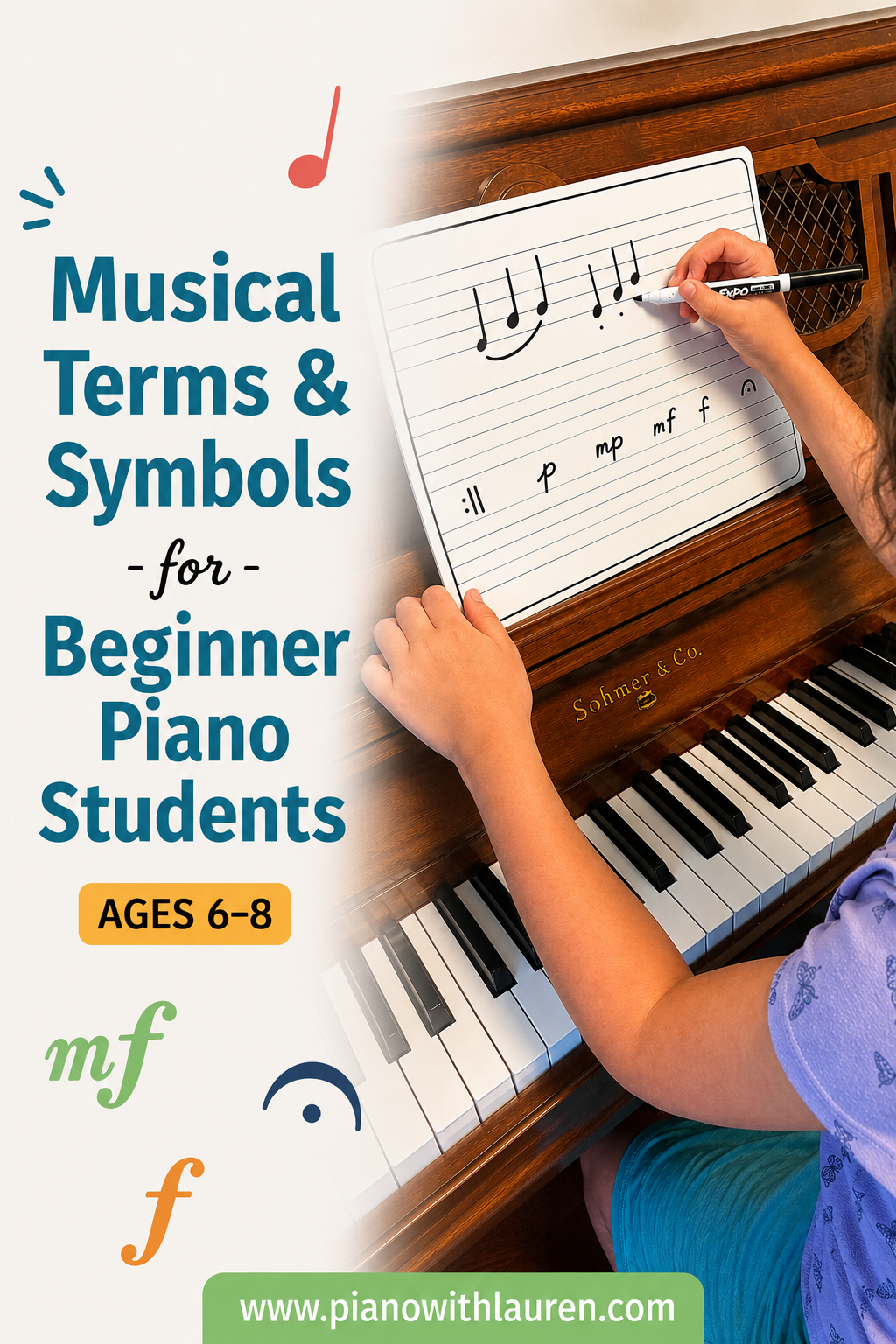
Use a marker board to draw musical symbols from memory.
Students can:
- draw dynamic markings
- draw repeat signs
- draw staccato dots
- draw slurs
- explain what each one means
This quick review reinforces recognition away from the piano.
Helpful Resources
🎵 Flashcards
Some note naming flashcards come with dynamic symbols. You can also easily make your own using index cards.
You can write the symbol on one side and the definition on the other to drill the symbols.
Another option is to write the symbol on one card and the definition on another card. Then have the student match terms to definitions.
🎲 Musical Terms Games
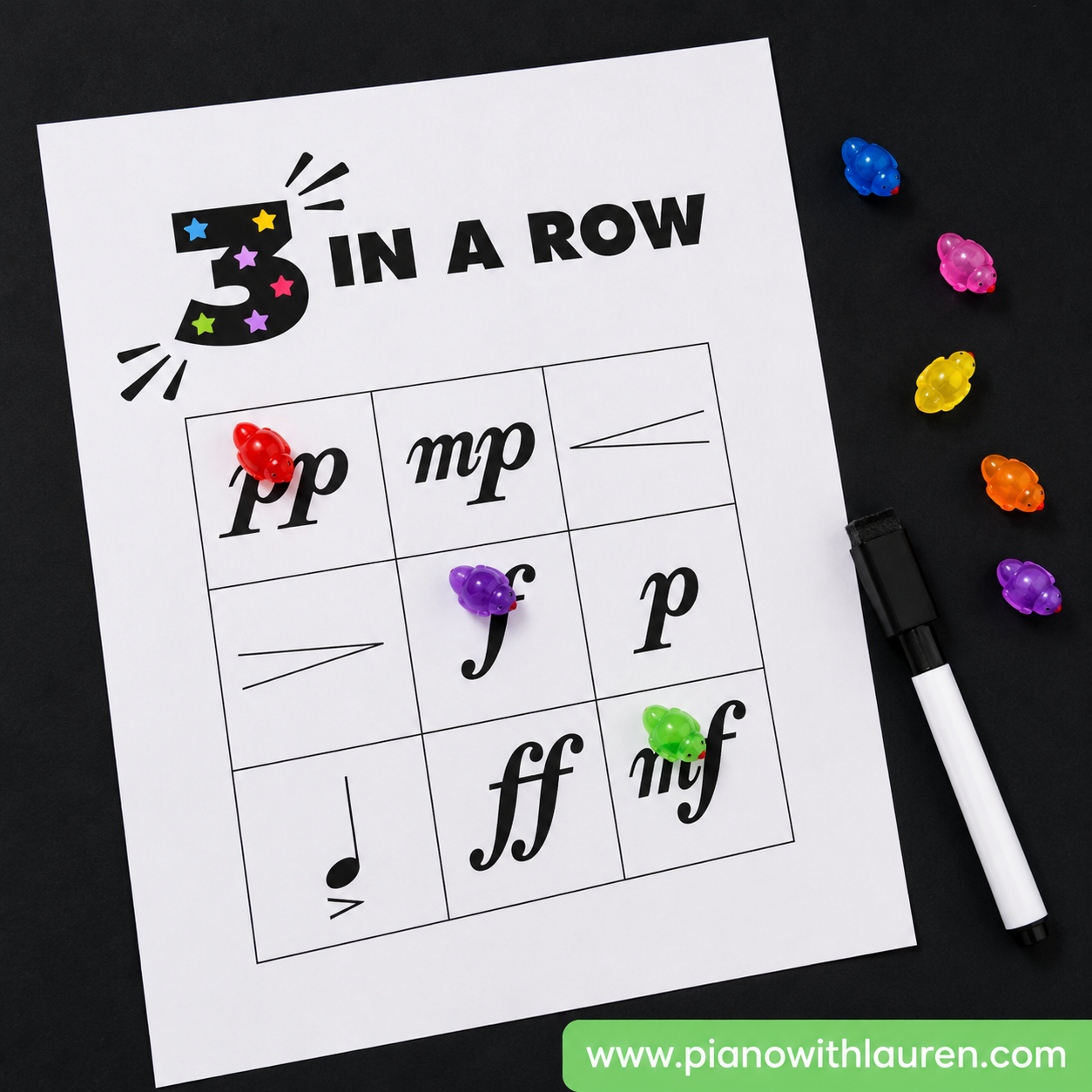
Games are a wonderful way to review vocabulary while keeping lessons enjoyable. Students often remember musical symbols more easily after using them in a game. 3 in a Row is a game I made to help my beginning students review some of these symbols.
Bringing It All Together
Learning musical terms and symbols helps beginner piano students become expressive musicians instead of simply playing the correct notes.
By introducing a few symbols at a time and reinforcing them through music, games, and written activities, students gradually become more confident readers and more thoughtful performers.
👉 Looking for a complete roadmap of beginning music theory?
Be sure to read Piano Theory for Beginners: What Students Ages 6–8 Need to Learn, where you’ll find all the essential music theory concepts every beginner should master.

Lauren teaches piano to students of all ages. She enjoys creating resources for her students and teachers. She is the author of Ready for Theory®. For personalized help, check out the consultations page for teachers.