This post may contain affiliate links. As a Sheet Music Plus and Amazon Associate, I earn from qualifying purchases. That means I make a small commission (at no additional cost to you) if you purchase something from an affiliate link.
Once a child sits down at the piano to practice, what should they actually do?
For beginning piano students, practice doesn’t need to be complicated. But it should be more specific than simply opening the lesson book and playing through a few songs.
Young students are still learning how to practice. They may not understand which skills need repetition, how to work on a difficult section, or even what their teacher means when they say, “Practice this piece.”
A clear practice plan can help.
While every student’s assignments will be a little different, most beginner piano practice can include a combination of technique, assigned pieces, specific practice goals, and review.
Start With the Teacher’s Assignment
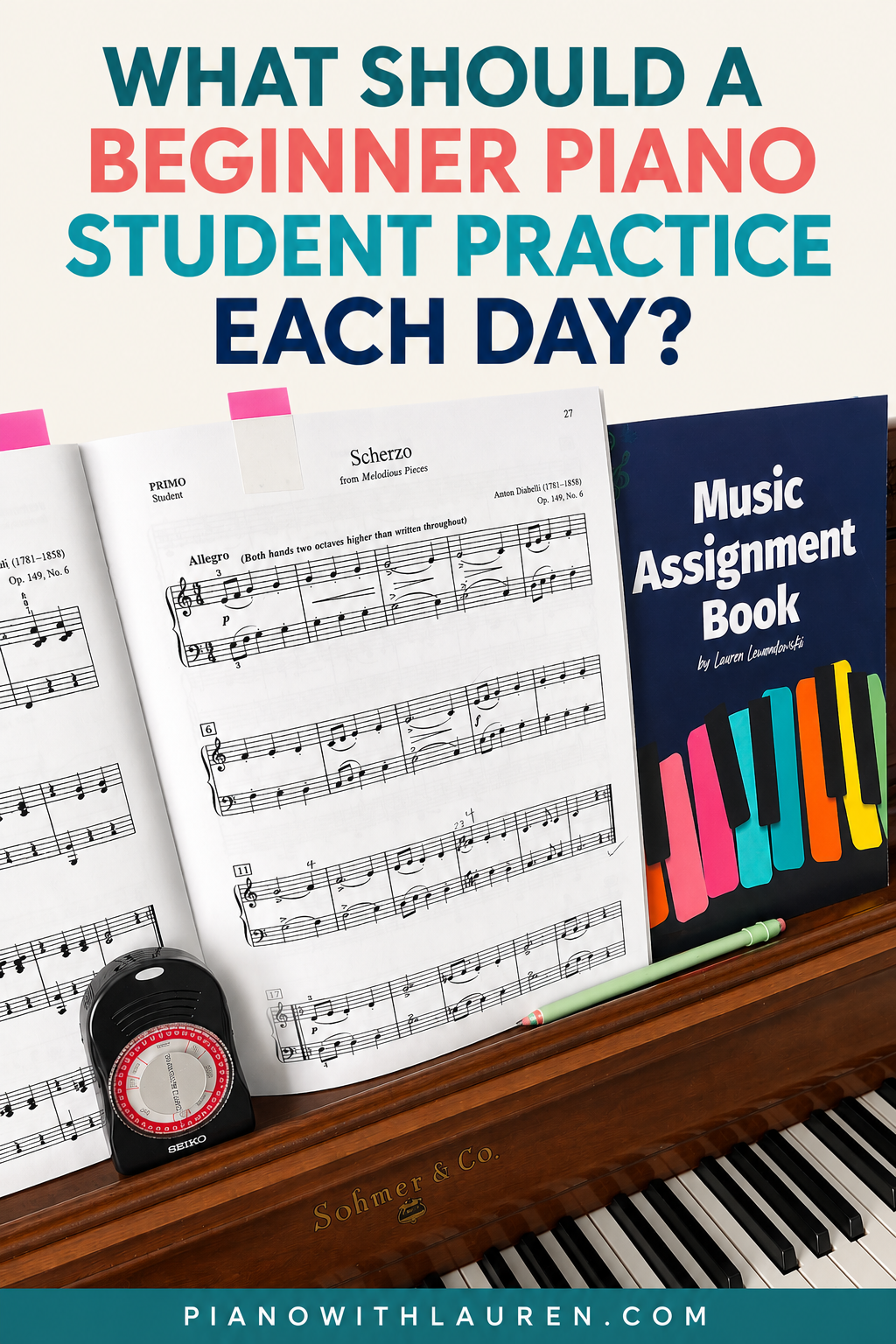
The first place to start is with whatever the piano teacher assigned during the lesson.
A clear assignment might include:
- specific pages or pieces to practice
- scales, chords, or other technique exercises
- sections that need extra attention
- theory or written work
- older pieces to review
For young beginners, it’s helpful when these instructions are written down rather than relying on the child to remember everything that happened during the lesson.
An assignment notebook or practice checklist can make this much easier.
Before practicing, the student (or parent) can look over the assignment and see exactly what needs to be accomplished.
Practice Technique
Depending on the student’s level and the teacher’s approach, practice may begin with a short technique assignment.
For a beginner, this doesn’t need to be extensive.
Technique might include:
- five-finger patterns
- scales
- chords
- arpeggios
- finger exercises
- a short technical exercise from the student’s method book
These activities give students an opportunity to develop coordination, fingering patterns, and familiarity with the keyboard outside of their repertoire.
Technique also benefits from repetition. Rather than playing a scale once and moving on, a teacher might ask a student to repeat it several times with a particular goal in mind.
For example:
Play the C major scale three times with the correct fingering.
Other examples of specific goals for technique can include focusing on hand position, firm fingers, or tone. That is much clearer to a student than simply writing C major scale on an assignment sheet.
Work on Assigned Piano Pieces
Repertoire will usually make up a large part of a beginner’s practice.
But practicing a piece doesn’t always mean playing it from beginning to end over and over.
Sometimes that is useful, particularly once a piece is nearly finished. At other times, a student may need to focus on one specific part of the music.
A teacher might ask a student to:
- learn the first eight measures hands together
- practice one hand at a time
- work on a difficult transition
- correct the rhythm in a particular measure
- add dynamics
- improve articulation
- practice a small section slowly
- repeat a difficult section several times
These kinds of assignments teach children that practice is about improving something, rather than simply playing through the music.
Break Difficult Sections Into Smaller Pieces
When a student encounters something difficult, the natural instinct is often to go back to the beginning of the piece and try again.
Unfortunately, that means the beginning gets practiced repeatedly while the difficult section may get very little focused attention.
Instead, students can learn to isolate the problem. It could something like isolating two measures, a difficult chord change, or a tricky move.
Work on that small section by itself.
A student might tap the rhythm, practice one hand separately, slow the section down, or repeat just those measures several times.
Once the smaller section feels comfortable, it can be added back into the surrounding music.
Learning to identify and work on these small problem areas is one of the most useful practice skills a student can develop.
Include Repetition
Young students don’t always understand how much repetition is involved in learning to play an instrument.
If a teacher assigns a new piece, a beginner may play through it once and genuinely believe they have practiced it.
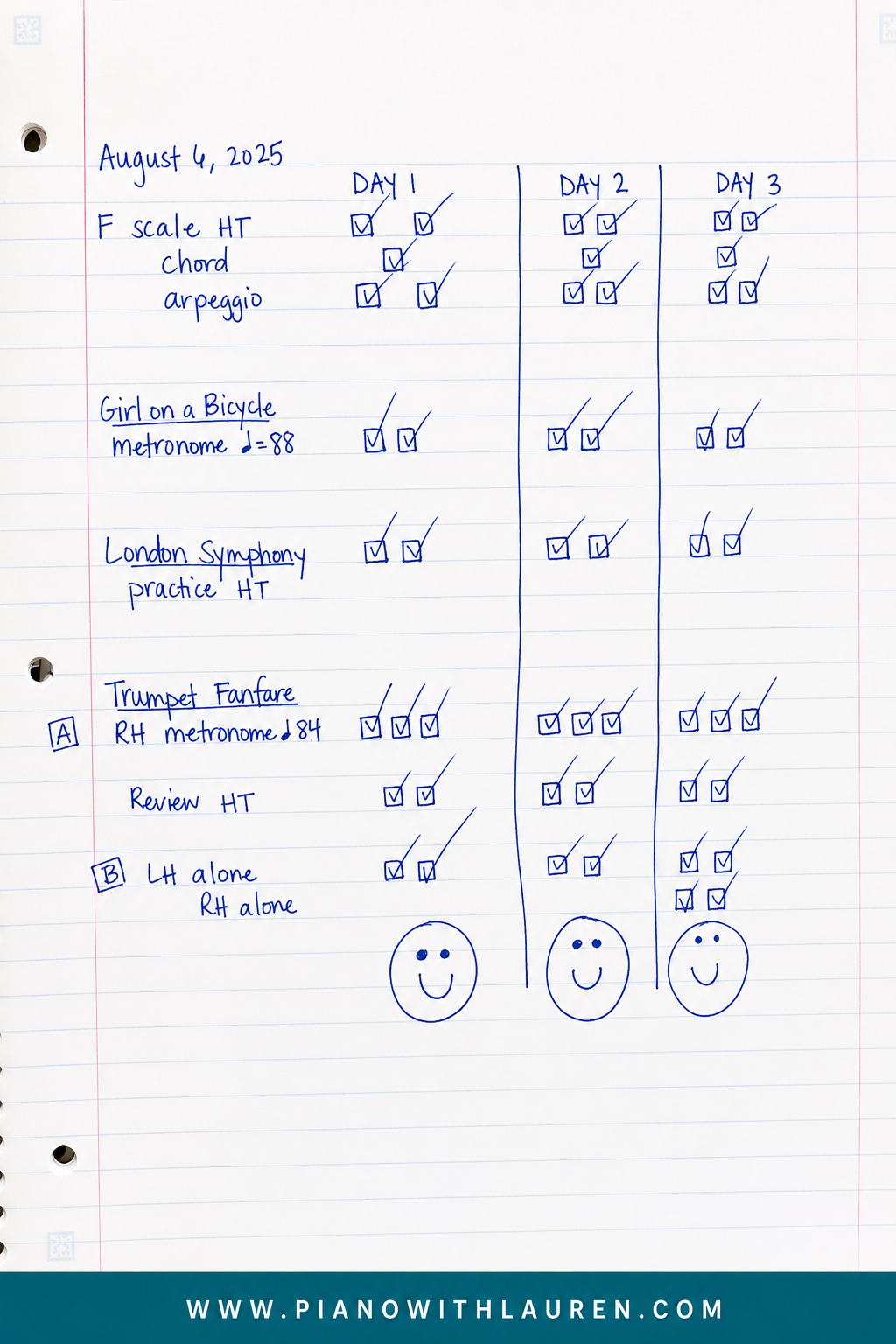
This is one reason I like using checklists with young students.
If I want a student to repeat something three times, I can give them three boxes to check. The student can see exactly what is expected rather than having to interpret a vague instruction like “practice this.”
Over time, they begin to understand that repetition is simply part of the learning process.
Of course, repetition should have a purpose. Playing the same mistake five times isn’t particularly helpful.
Whenever possible, give the repetition a goal:
Play this section three times with the correct notes.
Repeat these measures slowly until the rhythm is steady.
Play the scale three times without stopping.
Now the student knows both what to repeat and what they’re trying to improve.
Review Something That Is Already Comfortable
Not everything in a practice session needs to be difficult.
Students can also spend some time playing pieces they’ve already learned.
Reviewing older music reinforces skills, helps students build a repertoire of pieces they can play confidently, and gives them an opportunity to simply enjoy playing the piano.
For my own students, I make sure to separate review from practice. I suggest playing review pieces at the end of their practice session or have a separate day during the week to play music.
To help students keep a repertoire of music to review, you can simply keep a list of favorites or learned pieces in their assignment book. In the music assignment book I created, I have separate sections to keep track of “My Favorite Pieces to Play” and “Memorized Pieces.” You can add this to back of any assignment notebook or binder you’re using.
You can also use a special colored post-it or tab to mark review pieces in students’ books. For example, yellow tabs could be for practice while pink (or even their favorite color) be review.
After working carefully on new or difficult material, playing a favorite piece can remind a child how much progress they’ve already made. It is reward to build up a repertoire of learned pieces.
What About Theory and Other Activities?
Not every part of learning piano happens at the keyboard.
Depending on the student’s assignments, practice might occasionally include:
- completing a theory page
- reviewing flashcards
- clapping rhythms
- identifying notes
- listening to a recording
- doing an ear-training activity
These don’t necessarily need to happen every day.
Teachers can choose activities based on what the student is currently learning and where additional reinforcement would be helpful.
For a young beginner, I would keep these assignments short and purposeful rather than giving a long list of extra work simply for the sake of filling practice time.
A Simple Beginner Piano Practice Checklist
A beginner’s practice might look something like this:
Technique
- C major five-finger pattern hands together — 3 times
- C major chord hands separate— 3 times in each hand
Piece #1
- Measures 1–8 — hands separately for 2 days
- Try hands together slowly the rest of practice days
Piece #2
- Play through once
- Play measures 5–6 five times in a row
Review
- Play one favorite piece from a previous week
The exact assignments will change as the student progresses, but the structure is simple: practice a skill, work on current music, focus on something that needs improvement, and review something familiar.
Does a Beginner Need to Practice Everything Every Day?
Not necessarily. Practice should be realistic for the child’s age, level, and schedule.
If a student has several assignments, some days may focus more heavily on one piece than another. A particularly busy day might include technique and one important practice goal rather than the entire assignment.
The important thing is that students return to their assignments regularly throughout the week.
A short, focused practice session can still be valuable.
I’d rather have a child accomplish two specific practice goals than sit at the piano for a prescribed amount of time while playing through everything without much thought.
Parents Can Help Kids Know What to Practice
Young beginners may need some help managing their assignments at home.
Parents don’t need to know how to play the piano to help.
They can look at the teacher’s assignment with their child, help them find the correct pages, read the practice instructions, and remind them to check off completed tasks.
If something isn’t working or the instructions aren’t clear, make a note for the teacher.
Parents don’t need to correct every note or teach the lesson again at home. The goal is simply to provide enough structure for a young child to follow the practice plan.
As students become older and more experienced, they can gradually take over more of this responsibility themselves.
Beginner Piano Practice Should Have a Purpose
A good beginner practice session doesn’t need to be long or complicated.
What matters most is that the student understands what they’re working on and why they’re doing it.
Give young students specific assignments. Teach them how to isolate difficult sections. Make repetition concrete. Include technique and repertoire, but leave room for music they already enjoy playing.
Over time, the checklist becomes less necessary.
Students begin to recognize a difficult measure on their own. They know when they should slow down, separate the hands, or repeat a section. They begin deciding for themselves what needs attention.
And that’s ultimately one of our biggest goals: not simply getting children to practice piano, but teaching them how to practice independently.
Want more help with piano practice?
Read Piano Practice for Kids: A Guide for Parents & Teachers for more tips on building good practice habits, helping young students become independent, and making practice more manageable at home.
Looking for a piano or keyboard for a beginner?
You don’t need an expensive piano to get started, but having the right instrument can make learning much easier. I’ve put together my recommended pianos and keyboards for beginner students, including options at different price points and what to look for when choosing an instrument.
→ See The Best Keyboards for Starting Piano Lessons
Ready to Put It All Together?
Most of my blog posts explore one teaching topic at a time. If you’re looking for a complete first-year teaching roadmap, my course, Beyond the Lesson Book, shows how these concepts fit together across an entire year of beginner piano lessons.
🎹 Explore Beyond the Lesson Book

Lauren teaches piano to students of all ages. She enjoys creating resources for her students and teachers. She is the author of Ready for Theory®. For personalized help, check out the consultations page for teachers.