This post may contain affiliate links. As a Sheet Music Plus and Amazon Associate, I earn from qualifying purchases. That means I make a small commission (at no additional cost to you) if you purchase something from an affiliate link.
Learning to play the piano takes time, repetition, and regular practice. But for many families, figuring out what piano practice should actually look like can be one of the hardest parts of beginning lessons.
How long should a child practice? Do they need to practice every day? Should a parent sit with them? And what happens when a child simply doesn’t want to practice?
The good news is that piano practice doesn’t need to be long or complicated—especially for beginners. A consistent routine and a clear understanding of what to work on can make practice much easier for students and their families.
In this guide, I’ll share some ways parents and teachers can help young piano students develop practice habits that support their progress without making piano feel like a daily battle.
Why Piano Practice Matters
For most students, a piano lesson happens only once a week. That means much of the learning actually takes place during the days between lessons.
During a lesson, I can introduce a new piece, help a student understand a rhythm, demonstrate a technique, or show them how to work through a difficult section. Practice at home gives the student the repetition needed to become comfortable with those skills.
Without practice, students often return to their next lesson having forgotten much of what we worked on the week before. We then have to spend valuable lesson time reviewing the same material rather than moving forward.
Regular practice also helps playing the piano begin to feel easier. Notes become more familiar, rhythms are recognized more quickly, and movements that once required a lot of thought gradually become more automatic.
How Much Should Kids Practice Piano?
One of the most common questions parents ask is how much their child should practice.
For young beginners, consistency is more important than having long practice sessions.
A short, focused practice session several times throughout the week can be much more productive than sitting at the piano for a long session the night before the lesson.
The appropriate amount of practice also depends on the child’s age, level, attention span, and goals. A young beginner doesn’t need the same practice schedule as an advanced student preparing for a performance.
If given a timer, many students will look at the timer waiting for it to end. Instead of focusing only on a certain number of minutes, I like to think about whether the student has enough time to work through the important parts of the week’s assignment.
Create a Consistent Piano Practice Routine
One of the best ways to make practice easier is to make it part of the family’s normal routine.
When practice happens at a completely different time every day, it is easy to forget or continually put it off. Having a predictable practice time removes some of that decision-making.
The best time will be different for every family.
For one child, practicing shortly after school might work well. Another child may need time to eat and relax first. Some families may find that practicing before school works surprisingly well.
Look for a time when your child is generally alert and when practice can fit naturally into the day.
It doesn’t have to happen at exactly the same minute every day. The goal is simply for sitting down at the piano to become a familiar part of the routine rather than something that has to be negotiated each time.
Know What to Practice
Sometimes a student isn’t resistant to practicing—they simply don’t know what they’re supposed to do.
“Go practice piano” is a pretty broad instruction for a beginner.
A good practice assignment should give the student clear tasks to work on during the week. Depending on the student’s level, that might include:
- A few assigned pieces
- A scale or other technique exercise
- Reviewing a difficult measure or section
- A theory activity
- Sight-reading
- Reviewing an older piece
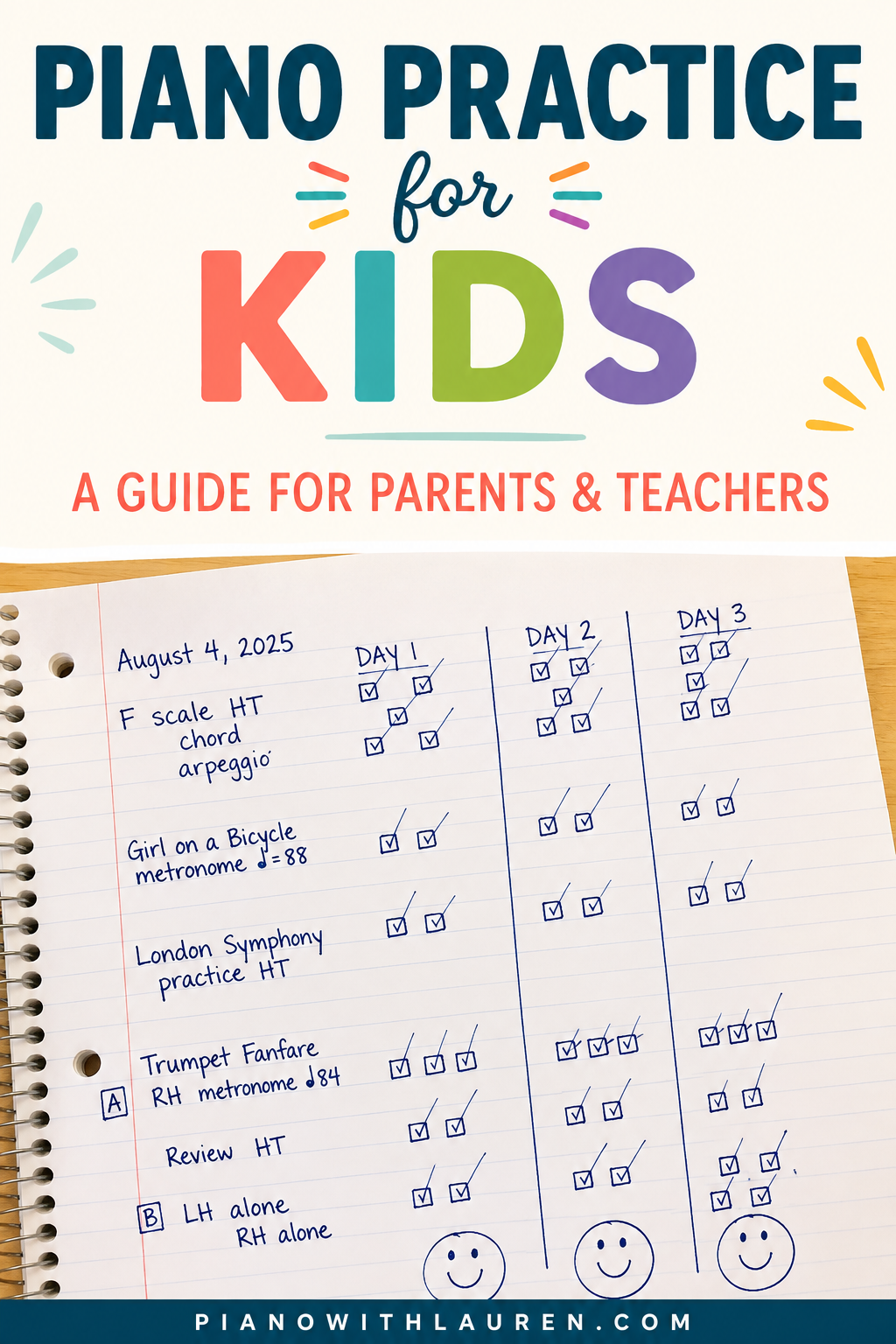
However, students will often need help learning how to practice rather than simply being told to practice. Many young students may benefit from a checklist so that they start understanding the repetition required throughout the week.
Additionally, learning skills such as isolating a difficult measure, working hands separately, clapping a rhythm, or repeating a small section will help students practice more effectively. These are skills that teachers can introduce during lessons so students gradually become more independent at home.
Keep Piano Practice Manageable
Longer isn’t always better.
Once a young child becomes tired or frustrated, continuing to practice often isn’t very productive. I’d rather see a student have a shorter, focused practice session than spend a long time at the piano while becoming increasingly upset.
Breaking an assignment into smaller pieces can help.
Instead of thinking, “I have to practice everything,” a student might begin with a scale, work on two pieces, and finish by playing a favorite piece.
Difficult music can also be divided into very small sections. Sometimes practicing two measures carefully is much more useful than playing an entire page over and over.
As students get older and more advanced, their ability to practice independently and for longer periods will grow.
When Your Child Doesn’t Want to Practice
Even students who enjoy piano will have days when they don’t feel like practicing.
The goal doesn’t need to be creating a child who enthusiastically runs to the piano every single day. Learning an instrument requires some work, and children won’t always be excited about every part of that process.
At the same time, constant arguments about practice can quickly make piano lessons unpleasant for everyone.
A consistent routine can help because practice becomes something that is simply part of the day. Clear, manageable assignments also make it easier for children to know when they’re finished.
Parents can also give children some ownership where possible. They might choose which piece to practice first or pick a favorite piece to play at the end.
Most importantly, try to look at the bigger picture. One difficult practice day—or even a difficult week—doesn’t mean piano lessons aren’t working.
What Is the Parent’s Role in Piano Practice?
Parents can make an enormous difference in a young student’s success, even if they don’t know how to play the piano themselves.
For younger beginners, expecting a child to independently remember everything from a weekly lesson and organize their own practice may simply be unrealistic.
A parent can help by:
- Reminding the child when it’s time to practice
- Helping them read the teacher’s assignment
- Making sure books and materials are available
- Encouraging them when something is difficult
- Helping create a regular practice routine
- Communicating with the teacher when something isn’t working
Parents don’t need to become the piano teacher at home.
In fact, if you’re unsure how something should be played, it’s often better to make a note and ask the teacher at the next lesson rather than turning practice into a struggle over who is correct.
The goal is to provide structure and encouragement while gradually helping the student become more independent.
Should Parents Sit With Their Child While They Practice?
This depends largely on the age and independence of the student.
A very young beginner will usually need more parent involvement. They may need help remembering what the teacher asked them to do, finding the correct page or position on the piano, or staying focused long enough to complete the assignment.
As children get older and become more experienced, parents can gradually step back.
Instead of sitting beside the piano for the entire practice session, a parent might help the child get started and then check in later.
The long-term goal is for students to take increasing responsibility for their own practice. But independence develops over time—it doesn’t have to happen during the first few months of lessons.
Teachers Can Make Home Practice Easier
Teachers also play an important role in whether practice goes smoothly at home.
I try not to assume that a young student will automatically know how to practice something just because we’ve worked on it during the lesson.
If I want a student to practice a tricky section in a particular way, we can practice that process together during the lesson first.
Clear assignments are also important. Parents shouldn’t have to guess what “practice this week” means.
Teachers can help by keeping assignments manageable, showing students specific practice strategies, and adjusting expectations when something clearly isn’t working.
It can also be helpful to talk directly with parents about practice expectations—particularly when a student first begins lessons. Many parents simply don’t know what is realistic because they’ve never had a child take music lessons before.
Focus on Progress, Not Perfect Practice
There will be weeks when practice goes wonderfully and weeks when very little happens.
Family schedules change. Children get sick. School gets busy. Vacations happen.
Consistency over a long period of time matters much more than having a perfect practice record.
I also don’t think every practice session needs to be incredibly productive. Sometimes simply sitting down, playing through a few pieces, and keeping the routine going has value.
As students become more experienced, we can teach them how to practice more efficiently and independently.
For young beginners, though, I want practice to accomplish two things: help them make progress and help them build a sustainable relationship with playing the piano.
Building Good Piano Practice Habits Takes Time
Learning how to practice is a skill in itself.
Young students aren’t going to know instinctively how to organize a practice session, fix a difficult measure, or stay motivated when something doesn’t come easily. Those skills develop gradually with guidance from both the teacher and the parent.
Start with a manageable routine. Give the student clear assignments. Help when needed, and gradually encourage more independence.
You don’t need perfect practice every day for a child to make meaningful progress at the piano.
A realistic routine that a family can maintain week after week will usually accomplish much more than an ambitious practice plan that lasts only a few days.
More Resources for Teaching Beginner Piano Students
- Best Piano Books for Beginners Ages 6-8
- Music Theory Games & Activities for Beginner Piano Students (Ages 6–8)
- Music Note Naming for Kids
- Piano Practice Steps for Beginners
- The Best Keyboards for Starting Piano Lessons
Ready to Put It All Together?
Most of my blog posts explore one teaching topic at a time. If you’re looking for a complete first-year teaching roadmap, my course, Beyond the Lesson Book, shows how these concepts fit together across an entire year of beginner piano lessons.
🎹 Explore Beyond the Lesson Book

Lauren teaches piano to students of all ages. She enjoys creating resources for her students and teachers. She is the author of Ready for Theory®. For personalized help, check out the consultations page for teachers.