This post may contain affiliate links. As a Sheet Music Plus and Amazon Associate, I earn from qualifying purchases. That means I make a small commission (at no additional cost to you) if you purchase something from an affiliate link.
Music theory is an important part of beginner piano lessons. I enjoy using games and activities for a tactile way to reinforce theory concepts.
For students ages 6–8, games and hands-on activities make music theory more engaging while helping concepts stick. Instead of relying only on only worksheets, students can move, create, write, and play their way through concepts.
Below are some of my favorite music theory activities organized by topic. Each section includes simple lesson ideas, along with links to more in-depth articles if you’d like additional teaching tips.
Note Reading Activities
Learning to read music is a developing skill. I add activities for these concepts so that students can recognize patterns away from the piano.
Some of my favorite note reading activities include:
- Musical alphabet card games
- Marker board activities
- Printable note naming flashcards
- Writing notes in a theory workbook
Moving between the staff, keyboard, and written activities helps students make stronger connections.
👉 Want more ideas? Read Music Note Naming for Beginner Piano Students (Ages 6–8).
Rhythm Activities
Rhythm is often one of the first music theory concepts beginners learn.
Students enjoy rhythm much more when they actively participate instead of simply counting aloud.
Some favorite rhythm activities include:
- Rhythm cards
- Echo clapping
- Creating rhythm patterns
- Classroom percussion instruments
Changing the activity each week keeps rhythm practice fresh while reinforcing the same concepts.
👉 Read more: Teaching Rhythm to Beginner Piano Students (Ages 6–8).
Interval Activities
Recognizing steps, skips, and intervals helps students begin reading music as patterns instead of individual notes.
Some fun interval activities include:
- Interval cards
- Drawing intervals on a marker board
- Interval Games (Rocket Intervals, Interval Flowers)
- Finding intervals in method books
Students often understand the patterns between intervals better when practiced away from the piano.
👉 Read more: Teaching Steps, Skips & Intervals to Beginner Piano Students (Ages 6–8).
Five-Finger Scales & Chord Activities
Once students understand note reading and intervals, they’re ready to explore simple five-finger scales and major chords.
Try activities such as:
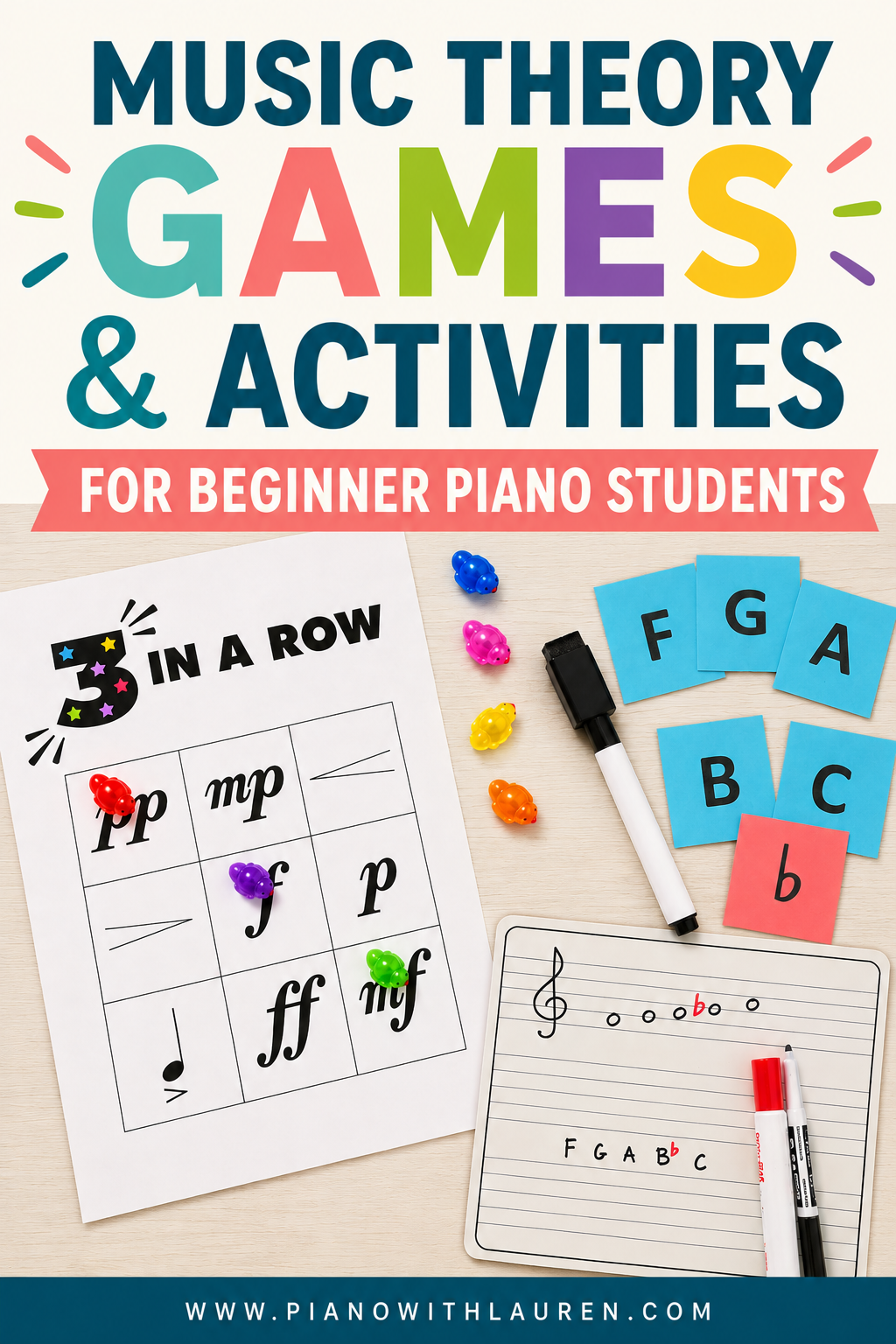
- Building scales with Alphabet & Accidental Cards
- Placing small manipulatives on each note of the scale
- Drawing scales on a marker board
- Completing theory workbook activities
- Identifying scales in method books
Experiencing scales in different ways helps students understand patterns instead of simply memorizing them.
👉 Read more: Major Five-Finger Scales & Chords for Beginner Piano Students (Ages 6–8).
Musical Terms & Symbols Activities
Dynamics, articulations, tempo markings, and repeat signs become much easier to remember when students interact with them regularly.
Some simple activities include:
- Games to review terms (3 in a Row)
- Musical terms flashcards
- Marker board review
- Finding symbols in lesson books
- Matching games
Short review games are often much more effective than long explanations. For beginners, I like to focus on definitions first. Memorizing “loud” when seeing “f” is easier for students to start.
👉 Read more: Musical Terms & Symbols for Beginner Piano Students (Ages 6–8).
Ear Training Activities
Strong listening skills help students become better musicians from the very beginning.
Easy ear training games include:
- High or Low?
- Same or Different?
- Echo Me
- Up or Down?
- Loud or Soft?
Most of these activities only take a few minutes. Ear training doesn’t need to be complex at this age. Just adding in a few minutes consistently in lessons will be beneficial.
👉 Read more: Ear Training for Beginner Piano Students (Ages 6–8).
Build Your Music Theory Activity Collection
One of the biggest mistakes teachers make is thinking they need dozens of games before they can teach music theory effectively.
You don’t.
Start with a few simple activities that you enjoy using. As you continuing teaching, gradually add printable games, manipulatives, theory books, and hands-on resources. Over time, you’ll build a collection of favorite activities that you can use year after year.
The goal isn’t to use a different game every lesson. Instead, rotate activities throughout the year so students continue reviewing familiar concepts in new and engaging ways.
Helpful Resources
Some of my favorite resources for teaching beginner music theory include:
- Ready for Theory Prep A & Prep B
- My First Piano Workbook
- Rhythm Cards
- Alphabet & Accidental Cards
- Rocket Intervals
These resources provide a variety of hands-on ways to reinforce music theory concepts while keeping students engaged throughout the lesson.
Music theory doesn’t have to be limited to worksheets or written exercises. By combining games, movement, listening activities, and hands-on resources, students develop a stronger understanding of music while having fun during lessons.
Remember, the goal isn’t to use every activity in every lesson. Instead, choose a few engaging activities that fit your teaching style and rotate them throughout the year. A variety of experiences helps students build confidence, retain concepts longer, and enjoy learning music theory from the very beginning.
Ready to Put It All Together?
Most of my blog posts explore one teaching topic at a time. If you’re looking for a complete first-year teaching roadmap, my course, Beyond the Lesson Book, shows how these concepts fit together across an entire year of beginner piano lessons.
🎹 Explore Beyond the Lesson Book

Lauren teaches piano to students of all ages. She enjoys creating resources for her students and teachers. She is the author of Ready for Theory®. For personalized help, check out the consultations page for teachers.