This post may contain affiliate links. As a Sheet Music Plus and Amazon Associate, I earn from qualifying purchases. That means I make a small commission (at no additional cost to you) if you purchase something from an affiliate link.
Once beginner piano students can identify notes on the staff, they’re ready to start recognizing one of the most important patterns in music: intervals.
Learning intervals helps students read music more quickly because they begin seeing the relationship between notes instead of identifying every note individually. This pattern recognition leads to better sight-reading, faster learning, and greater confidence at the piano.
For students ages 6–8, start with the simplest intervals—steps and skips—before introducing larger intervals like 4ths and 5ths.
Here are the interval concepts every beginner should learn.
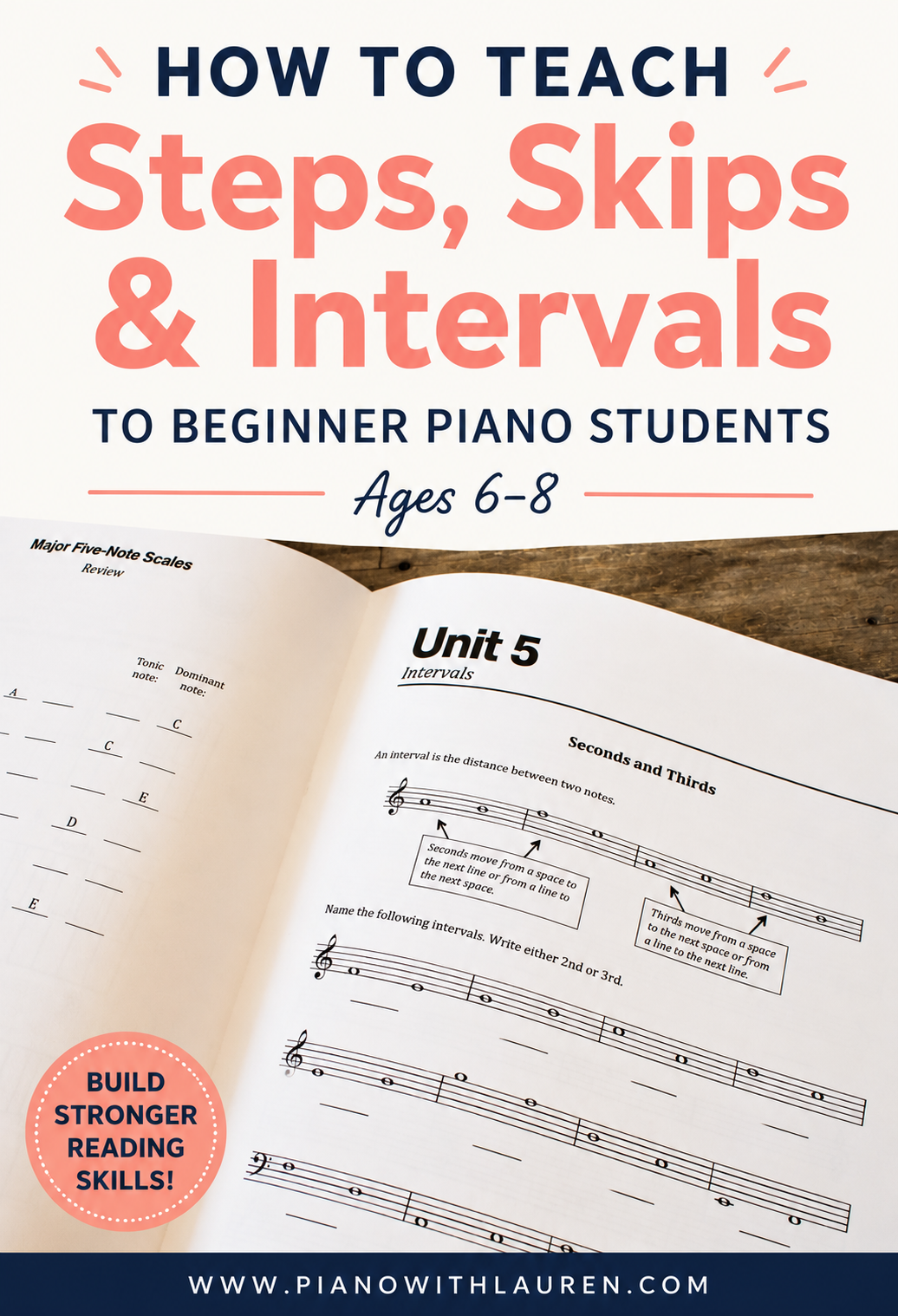
What Are Intervals?
An interval is simply the distance between two notes.
For beginning piano students, the first intervals to learn are:
- 2nds (Steps)
- 3rds (Skips)
- 4ths
- 5ths
As students become comfortable recognizing these patterns, reading music becomes much less overwhelming.
Steps (2nds)
A step moves from one note to the very next note on the musical staff.
Examples include:
- Line to the next space
- Space to the next line
On the keyboard, a step moves to the next letter of the musical alphabet.
Examples:
C → D
F → G
A → B
Students should learn to recognize that steps can move both up or down.
Skips (3rds)
A skip moves over one note to the next.
On the staff, skips move:
- Line to line
- Space to space
On the keyboard:
C → E
D → F
F → A
Recognizing skips helps students begin reading music in larger patterns rather than one note at a time.
Students who need extra support may benefit from using consistent colors in their music. For example, for the first few pieces with thirds, it can help to use the same color to mark that interval. I made a free chart for the colors I use with my students.
👉 For extra tips helping beginning students recognize steps and skips in their music, check out:
Piano Practice Steps for Beginners
Introducing 4ths and 5ths
Once students are comfortable with steps and skips, they can begin recognizing larger intervals.
At this stage, students don’t need advanced interval theory. Instead, focus on visual recognition.
Ask questions like:
- Does this interval move line to space?
- Is it larger than a skip?
- Can you recognize this pattern without counting?
Over time, students naturally begin identifying 4ths and 5ths by sight.
Practice Activities for Learning Intervals
Draw Intervals on a Marker Board
One of the simplest teaching tools is a dry-erase board.
Here are some of my favorite ways to practice intervals with a marker board.
1. DRAWING:
Draw one note on the staff and ask your student to:
- Draw a step higher.
- Draw a step lower.
- Draw a skip higher.
- Draw a skip lower.
- Draw a 4th.
- Draw a 5th.
Because students are creating the intervals themselves, they develop a much stronger understanding than by simply answering worksheets.
2. NAMING:
Draw several intervals on the marker board and ask the student to name them as quickly as possible. Students love to race!

Use Interval Flashcards
Interval Flashcards are a quick and effective way to build interval recognition.
Hold up a card and ask:
- Step or skip?
- 2nd, 3rd, 4th, or 5th?
- Up or down?
This takes only a few minutes during each lesson and provides excellent review.
Make Interval Practice Fun
Games are one of the easiest ways to reinforce interval recognition because they turn repetition into something students actually enjoy. Instead of drilling the same concepts over and over, students stay engaged while practicing steps, skips, and larger intervals.
Whether you use printable games, flashcards, or hands-on activities, a few minutes of interval practice during each lesson can build speed, confidence, and pattern recognition.
Tips for Teaching Intervals
- Teach visual patterns before memorization.
- Encourage students to recognize intervals without counting every note.
- Review intervals often.
- Connect intervals on the staff to the piano keyboard.
- Practice identifying intervals in method book pieces as students encounter them.
The goal isn’t simply memorizing interval names—it’s helping students begin reading music by recognizing patterns.
Helpful Interval Resources
Students master intervals much more quickly when they have a variety of opportunities to practice.
Here are some of my favorite resources:
🚀 Rocket Intervals
Help students practice identifying steps, skips, and beginning intervals through an engaging space-themed game.
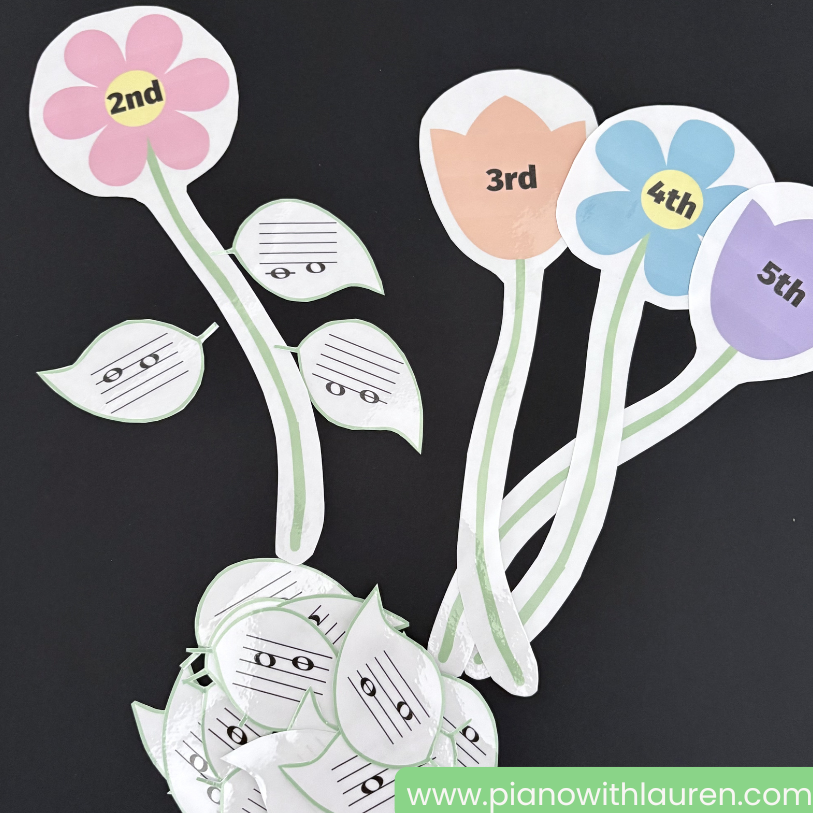
🌼 Interval Flowers
A colorful game that reinforces interval recognition while making music theory fun.
📘 Ready for Theory
My Ready for Theory Prep A and Prep B workbooks include interval activities alongside note recognition and other beginning music theory concepts, making them an excellent supplement for ages 6–8.
🃏 Interval Flashcards
Flashcards are perfect for quick reviews during lessons and make an excellent addition to any piano teacher’s studio.
✏️ Dry-Erase Staff Board
A reusable marker board gives students an opportunity to draw, identify, and create intervals during lessons.
Bringing It All Together
Teaching intervals is one of the biggest steps toward fluent music reading. When students begin recognizing steps, skips, and larger interval patterns, they spend less time identifying individual notes and more time focusing on making music.
By combining visual recognition, hands-on activities, games, and regular review, you’ll help students develop interval-reading skills that will support them throughout their piano studies.
👉 Looking for a complete guide to beginning music theory?
Be sure to read Piano Theory for Beginners: What Students Ages 6–8 Need to Learn, where you’ll find a complete roadmap of the essential theory concepts every beginner should master.

Lauren teaches piano to students of all ages. She enjoys creating resources for her students and teachers. She is the author of Ready for Theory®. For personalized help, check out the consultations page for teachers.