This post may contain affiliate links. As a Sheet Music Plus and Amazon Associate, I earn from qualifying purchases. That means I make a small commission (at no additional cost to you) if you purchase something from an affiliate link.
Getting kids to practice the piano regularly can be one of the biggest challenges for parents. Between school, homework, activities, dinner, and everything else that fills the week, piano practice can easily become something everyone remembers right before the next lesson.
The good news is that a successful piano practice routine doesn’t need to involve long practice sessions or practicing at exactly the same time every day.
In fact, for most young beginners, short, regular, focused practice is much more valuable than simply accumulating practice minutes.
Here are some simple ways to create a piano practice routine that works for your family.
Connect Piano Practice to Your Family’s Routine
One of the easiest ways to make piano practice more consistent is to connect it to something that already happens regularly in your home.
For example, piano practice might happen:
- after breakfast
- after school and a snack
- before dinner
- after dinner
- before getting ready for bed
This doesn’t mean your child needs to sit at the piano at exactly 6:30 every evening.
Instead, think of practice as happening around an activity rather than at a specific time.
For example, “We practice after dinner” is often easier to maintain than “We practice at 6:30.”
Some nights dinner might end at 6:15 and other nights it might be 7:00. That’s okay. The activity itself becomes the reminder: Dinner is finished, so now it’s time to play the piano.
This type of routine is flexible enough to work with real family life while still making piano practice predictable.
Keep Practice Sessions Short and Regular
Young beginners don’t need long practice sessions to make progress.
In most cases, short practice sessions throughout the week are much more effective than one long practice session before the lesson.
A child who practices for 10–15 focused minutes on several days of the week is getting repeated opportunities to reinforce what was learned in the lesson. Notes become more familiar, movements become more automatic, and pieces have time to develop gradually.
Compare that with practicing for 45 minutes the night before the lesson. Even though the total number of minutes might be similar, the learning experience is completely different.
Consistency matters more than cramming.
Shorter sessions can also make practice feel much more manageable to children. Sitting down for a few focused tasks feels achievable, especially after a long school day.
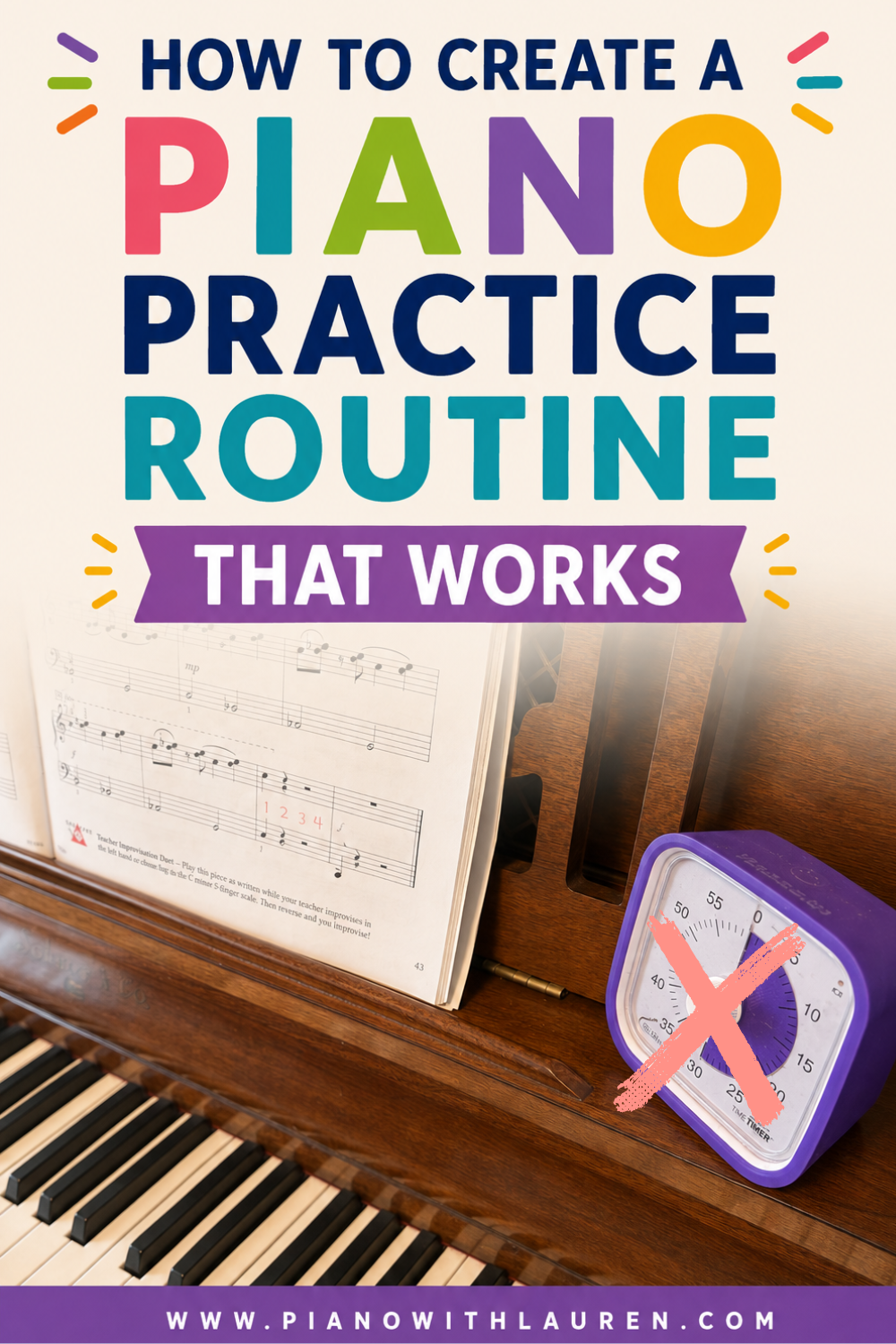
Focus on Practice Goals Instead of the Clock
One of my favorite ways to approach piano practice is to focus on what needs to be accomplished rather than how many minutes need to pass.
When children are told to “practice for 20 minutes,” something funny often happens.
They watch the timer.
Instead of thinking about how to improve the music, they’re wondering:
How much longer do I have?
A child can technically sit at the piano for 20 minutes without accomplishing very much.
That’s why I prefer giving students specific practice goals.
A practice goal might be:
- get one section hands together
- fix the notes in measures 5–8
- practice the left hand three times slowly
- add the correct dynamics
- make the staccato notes sound lighter
- practice a difficult transition between two measures
- play a scale with the correct fingering
- play through a piece without stopping
These goals give children a clear reason for practicing.
Instead of thinking, I have to sit here for 20 minutes, they’re thinking, I’m trying to get these four measures hands together.
That small shift can make practice much more productive.
Give Kids a Clear Starting Point
Sometimes children resist practicing simply because they don’t know what they’re supposed to do when they sit down.
“Go practice piano” is actually a pretty broad instruction.
A young beginner may open the book, play through a favorite piece, flip through a few pages, and decide they’re finished.
This is where a clear assignment from the teacher can make a big difference.
At the end of the lesson, students should know not only what to practice, but also how to practice it.
Instead of writing only a page number in an assignment notebook, a teacher might write:
Page 24 — Practice measures 1–8 hands separately, then try hands together.
Now the child has a concrete task to accomplish.
Parents don’t need to become the piano teacher at home. They can simply help their child remember what the teacher asked them to work on.
Break Bigger Goals Into Small Tasks
“Learn this piece” can feel overwhelming to a young student.
Smaller goals make progress much easier to see.
Instead of trying to improve an entire piece at once, a student might work on:
Day 1: Learn the right hand of the first section.
Day 2: Add the left hand.
Day 3: Try the section hands together slowly.
Day 4: Work on dynamics and articulation.
Day 5: Play through the piece and identify any spots that still need work.
The exact plan will vary depending on the student and the music, but the principle is the same.
Small, specific goals make practice more manageable.
They also give children the satisfaction of accomplishing something each time they sit at the piano.
Practice Doesn’t Have to Look the Same Every Day
A consistent routine doesn’t mean every practice session needs to be identical.
Some days your child may have plenty of energy and spend longer at the piano. Other days may be packed with homework, activities, or family plans.
On a busy day, your child might simply practice the most difficult section of a piece and review a scale.
That’s still worthwhile practice.
It’s much better to have a short, focused session than to skip practice because there isn’t enough time for the “full” routine.
This flexibility can also help piano practice remain sustainable over the long term.
Help Without Taking Over
Parents play an important role in helping young children establish a practice routine, but you don’t need to supervise every note.
For younger beginners, your role may simply be to:
- remind them that it’s practice time
- help them read the teacher’s assignment
- encourage them to work toward one or two specific goals
- notice and celebrate progress
As children get older and more independent, they can gradually take more responsibility for remembering when to practice and deciding how to work toward their goals.
The ultimate goal isn’t for a parent to manage piano practice forever. It’s to help children develop the skills they need to practice independently.
What If Your Child Doesn’t Want to Practice?
Even with a good routine, there will be days when your child doesn’t feel like practicing.
That can be normal.
Rather than turning every practice session into a negotiation, having an established routine helps remove some of the decision-making.
If piano usually happens after dinner, there isn’t a daily question of Are we practicing today?
It’s simply part of the evening rhythm.
On particularly difficult days, make the goal small.
“Let’s work on those four measures your teacher circled.”
Often, getting started is the hardest part.
And if the practice session ends up being only five or ten productive minutes, that’s okay. Regular contact with the instrument is still valuable.
A Good Piano Practice Routine Is Simple
The best piano practice routine isn’t necessarily the one with the most detailed schedule or the longest practice sessions.
It’s the one your family can actually maintain.
Connect practice to the natural rhythm of your day. Keep sessions short enough to be manageable. Give children clear goals to work toward. And focus on what they’re accomplishing at the piano rather than how long they’re sitting there.
Over time, those short and focused practice sessions add up.
And more importantly, children begin learning one of the most valuable skills a young musician can develop: how to practice with a purpose.
👉 Want more help with piano practice? Read Piano Practice for Kids: A Guide for Parents & Teachers for more tips on building good practice habits, helping young students become independent, and making practice more manageable at home.

Lauren teaches piano to students of all ages. She enjoys creating resources for her students and teachers. She is the author of Ready for Theory®. For personalized help, check out the consultations page for teachers.