This post may contain affiliate links. As a Sheet Music Plus and Amazon Associate, I earn from qualifying purchases. That means I make a small commission (at no additional cost to you) if you purchase something from an affiliate link.
Getting kids to practice the piano can sometimes feel harder than the actual piano lesson.
You remind them to practice. They don’t want to. You remind them again. They complain. Eventually, everyone is frustrated — and piano practice has somehow become the least enjoyable part of the day.
Some resistance to practice is completely normal, especially with young children. Even kids who enjoy playing the piano aren’t necessarily going to feel excited about practicing every single day.
But piano practice doesn’t have to become a daily battle.
A few simple changes can reduce the negotiations and help practice become a normal, manageable part of your child’s routine.
Make Piano Practice Part of the Routine
One of the best ways to reduce arguments about piano practice is to remove the daily decision of when it’s going to happen.
Instead of deciding each day, connect piano practice to something that already happens regularly in your home.
For example, piano practice might happen:
- after breakfast
- after school and a snack
- before dinner
- after dinner
- before getting ready for bed
I prefer connecting practice to an activity rather than a specific time.
“We practice after dinner” is often much easier to maintain than “We practice at 6:30.”
Some nights dinner might end at 6:15 and other nights it might be 7:00. That’s okay. The activity itself becomes the cue.
When practice has a predictable place in the day, there’s less room for an ongoing negotiation about whether it’s going to happen.
Keep the Practice Session Manageable
A child who is already reluctant to practice probably isn’t going to become more enthusiastic when they’re told they need to sit at the piano for 30 minutes.
Young beginners usually don’t need extremely long practice sessions.
I’d much rather see a student have a short, focused practice session on several days of the week than struggle through one long session because a timer says they aren’t finished yet.
On a busy or difficult day, practice might be very simple:
Play your scale. Work on the tricky four measures. Play through your new piece. Done.
Five or ten productive minutes can still be worthwhile.
Making practice feel manageable can eliminate some of the resistance before it starts.
Give Your Child a Clear Finish Line
“Go practice piano” is a surprisingly vague instruction.
A child doesn’t necessarily know what that means.
Do they play every piece? How many times? Do they practice scales? What about the part their teacher circled? And when are they finished?
A clear practice assignment gives a child a finish line.
Instead of:
Practice for 20 minutes.
Try:
Play your C major scale, practice measures 5–8 three times slowly, and play your new piece hands separately.
Now the child knows exactly what needs to happen.
There’s also less opportunity for the classic:
“Am I done yet?”
The answer isn’t determined by how long they’ve been sitting there. It’s determined by whether they’ve completed the practice goals.
Let Your Child Check Off Their Own Work
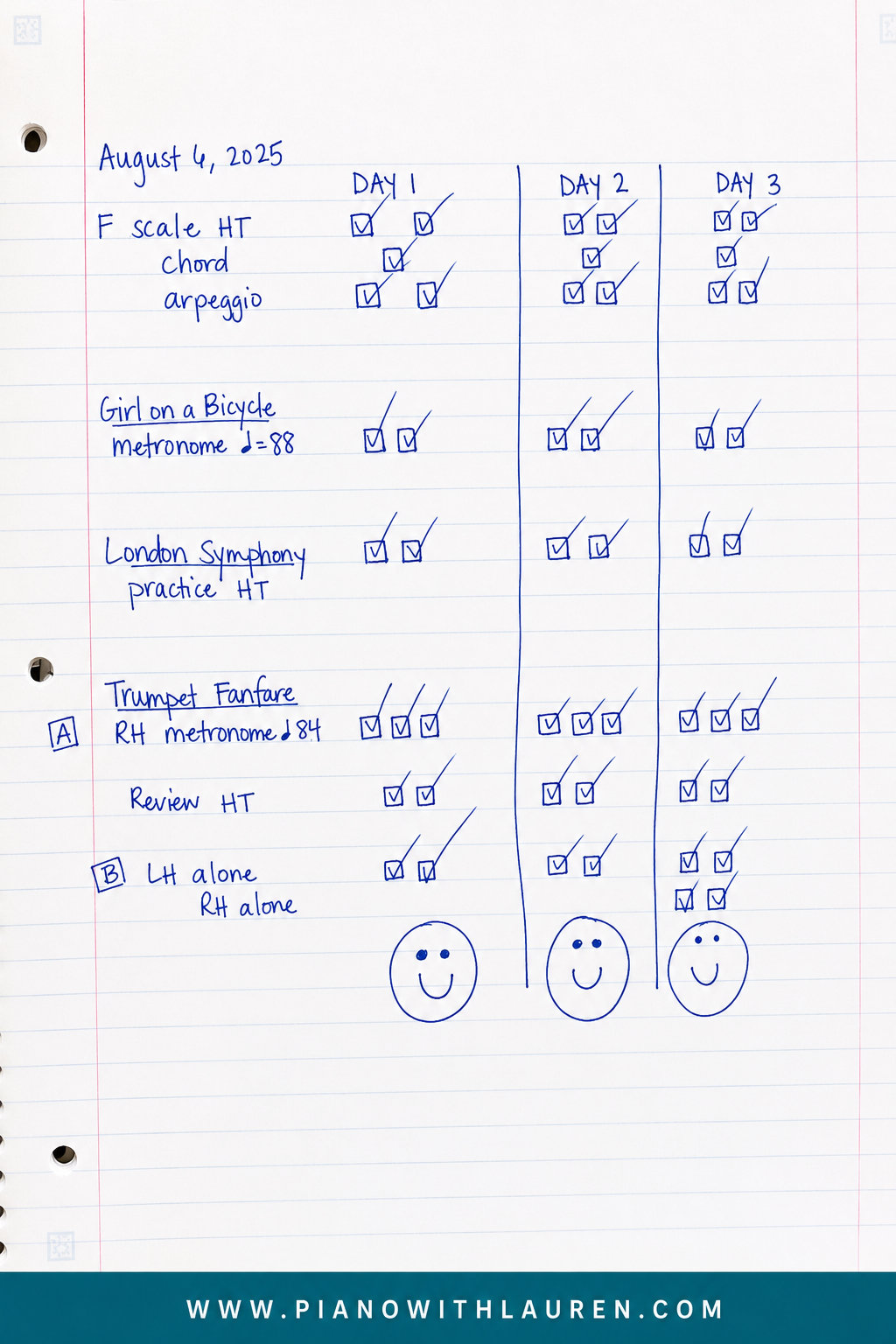
A simple checklist can give young students a surprising amount of ownership over practice.
The teacher might write down several specific tasks and provide boxes for the student to check as they complete them.
Instead of Mom or Dad constantly saying:
“Now do your scale.”
“Did you practice the second piece?”
“You still need to do your left hand.”
the child can look at the list and see what’s next.
Let them make the checkmark.
It’s a tiny thing, but it shifts some of the responsibility from the parent to the child.
Over time, you’re helping them learn how to manage their own practice rather than relying on an adult to direct every step.
Don’t Turn Practice Into Another Piano Lesson
Parents sometimes feel like they need to supervise piano practice and correct everything that goes wrong.
You don’t.
In fact, constantly correcting notes, rhythms, fingering, and technique can quickly turn practice into a frustrating experience for everyone.
Your child’s piano teacher is responsible for teaching the music.
Your job at home is primarily to help your child develop the habit of practicing.
If something is obviously going wrong, you can always point your child back to the assignment:
“What did your teacher ask you to do with that part?”
But you don’t need to sit beside the piano and correct every mistake.
Sometimes it’s perfectly fine to let the teacher handle it at the next lesson.
Give Choices When You Can
Children don’t need complete control over whether they practice, but giving them some control within the practice session can reduce resistance.
Try choices like:
“Do you want to start with your scale or your piece?”
“Which piece do you want to practice first?”
“Do you want to do the hard section now or after your warm-up?”
The necessary work still gets done, but the child has some say in how it happens.
For many kids, that’s enough to make practice feel less like something being imposed on them.
Focus on the Goal Instead of the Timer
I’ve never loved using a timer as the main goal for piano practice.
Tell a child to practice for 20 minutes and there’s a good chance they’ll spend part of those 20 minutes wondering:
How much longer?
A student can technically sit at the piano for 20 minutes without accomplishing very much.
Instead, focus on what they’re trying to accomplish.
Maybe today’s goal is to:
- play a section hands together
- fix the rhythm in two measures
- play a scale with the correct fingering
- add dynamics
- make the staccato notes lighter
- play through a piece without stopping
When the goal is concrete, children can experience the satisfaction of actually finishing something.
That’s very different from simply waiting for a timer to go off.
Notice Progress
When piano practice has become a source of conflict, it’s easy for most of the conversation around it to become negative.
“You haven’t practiced yet.”
“You need to do that again.”
“Your teacher told you to work on that.”
Try noticing what’s improving, too.
You might say:
“That section sounds much smoother than it did yesterday.”
“You remembered that fingering this time.”
“You got those measures hands together!”
You don’t need to praise every note your child plays. Simply noticing genuine progress helps children make an important connection:
Practicing makes things easier.
That’s one of the most valuable lessons they can learn.
Know When to Make Practice Smaller
Some days are just hard.
Your child may be tired from school, have a lot of homework, or simply be having a bad day.
That doesn’t necessarily mean piano practice has to disappear completely.
Make the goal smaller.
Instead of insisting on the entire assignment, you might say:
“Let’s just work on those four measures your teacher circled.”
Often, starting is the hardest part. Your child may continue once they’re at the piano.
And if they don’t? They still had a few minutes of meaningful contact with the instrument.
Flexibility is different from giving up on the routine.
Gradually Step Back
Young beginners need help learning how to practice.
At first, you may need to remind your child that it’s practice time, open the assignment book with them, and help them figure out what to do first.
But you don’t want to manage every practice session forever.
As your child becomes more capable, gradually hand over pieces of the responsibility.
Maybe they start checking their own assignments.
Then they choose the order of their practice tasks.
Eventually, they may start practicing without being reminded.
The goal isn’t immediate independence. It’s a gradual transfer of responsibility from parent to student.
What If My Child Still Complains About Practicing?
They probably will sometimes.
A child complaining about piano practice doesn’t automatically mean something is wrong.
Kids complain about homework, brushing their teeth, cleaning their rooms, and plenty of other things that are simply part of life.
You don’t necessarily need to convince your child to want to practice every day.
Sometimes the most helpful response is simply to keep the routine calm and predictable.
Piano happens after dinner.
The assignment is clear.
The work is manageable.
When it’s finished, they’re done.
Removing the negotiation can sometimes remove much of the conflict along with it.
Piano Practice Doesn’t Have to Be a Battle
The goal isn’t to create a child who happily skips to the piano every single day.
It’s to make piano practice a normal part of life.
Keep practice manageable. Give your child clear goals. Offer choices where you can. Avoid correcting every mistake. And gradually give your child more responsibility for their own practice.
Over time, the conversation can shift from:
“You need to go practice piano!”
to:
“What are you working on today?”
And that’s a much healthier foundation for raising a child who can eventually practice independently.
More Help With Piano Practice
Building good practice habits takes time. These articles can help you create a routine that works for your child and gradually encourage more independent practice.
- Piano Practice for Kids: A Guide for Parents and Teachers
- How to Create a Piano Practice Routine That Works
- How to Get Your Child to Practice Without a Battle
- How Often and How Long Should Kids Practice Piano?
- Should Parents Sit With Their Child During Piano Practice?
- How Parents Can Help With Piano Practice—Even If They Don’t Play Piano
Ready to Put It All Together?
Most of my blog posts explore one teaching topic at a time. If you’re looking for a complete first-year teaching roadmap, my course, Beyond the Lesson Book, shows how these concepts fit together across an entire year of beginner piano lessons.
🎹 Explore Beyond the Lesson Book

Lauren teaches piano to students of all ages. She enjoys creating resources for her students and teachers. She is the author of Ready for Theory®. For personalized help, check out the consultations page for teachers.