This post may contain affiliate links. As a Sheet Music Plus and Amazon Associate, I earn from qualifying purchases. That means I make a small commission (at no additional cost to you) if you purchase something from an affiliate link.
Planning piano lessons can feel overwhelming, especially when you’re teaching beginning students. You may have a method book to follow, but the method book is only one part of a well-rounded piano lesson. There are also technique, theory, sight reading, supplemental music, activities, and performance opportunities to think about.
Trying to decide what to teach every single week can quickly turn into a lot of preparation. I find it much easier to step back and look at the bigger picture first. Instead of planning each piano lesson as an isolated 30-minute block, I like to think about where I want a student to go over the course of the year. Once I have that overall direction, planning individual lessons becomes much easier.
Start With the Big Picture
Before thinking about what you’ll do in next week’s lesson, think about the student you’re teaching and where you’d like that student to be several months from now.
For a beginner, you might consider questions such as:
- What skills will this student be working toward?
- What method books are appropriate for their age?
- What kinds of music might motivate them?
- Are there performances or studio events coming up?
- What areas will need to be taught outside of the method book?
You don’t need to predict exactly where a student will be at the end of the year. Students progress at different rates, and plans will inevitably change. The goal is simply to have a direction. I think of it a little like having a map—you can take a detour when you need to, but it’s much easier to make decisions along the way when you know where you’re trying to go.
This idea of having a bigger-picture plan for beginner students is actually what led me to create my course, Beyond the Lesson Book. I wanted teachers to have a clearer roadmap for the first year of lessons, while still having the flexibility to adapt it for individual students.
Choose Books With the Year in Mind
One of the things I like to do is think about the books I expect to use with a student for the entire year. That includes the student’s method books as well as supplemental solo music.
I don’t necessarily expect every student to move through the same amount of material. Some students progress quickly, while others may spend much longer on a particular level. But having books in mind ahead of time helps me see the overall progression.
For example, I can think about whether a student’s method book provides enough repertoire, whether I’ll want to add a supplemental solo book, and what music might be appropriate as the student develops throughout the year. This also keeps me from constantly scrambling to find the next piece. Rather than asking, What should I give this student this week?, I’ve already thought about several possibilities and can choose the one that fits where the student is now.
If you’re interested in learning about books for beginners, check out my post Best Piano Books for Beginners.
Think Ahead to Performances and Events
The studio calendar also influences my lesson planning. If students will have opportunities to perform during the year, I want to think about those events well before they arrive. That might include a recital, festival, holiday performance, studio class, or another special event.
If I know a performance is coming, I can start thinking about repertoire early enough that we don’t have to rush. I can consider what type of piece would fit the event, which students might be ready for a challenge, who may need something more comfortable, and how much preparation time each student will need.
Performance pieces then become part of the larger plan for the year rather than something I suddenly need to squeeze into lessons a few weeks before an event. Of course, plans can change. A piece that seemed perfect in September might not be the right choice by November, but having possibilities in mind makes it much easier to adjust than starting from scratch every time.
Don’t Let the Method Book Plan the Entire Lesson
Method books can provide a helpful sequence for beginner students, but I don’t think they should determine everything that happens in a piano lesson. A method book may introduce a concept, but a student may need to experience that concept in several different ways before it really makes sense.
Beginner lessons can also include things like:
- technique
- rhythm
- note reading
- ear training
- sight reading
- improvisation
- theory
- supplemental repertoire
- games and activities
You certainly don’t need to fit every one of these into every lesson. Instead, think about which areas would be most useful for the student you’re teaching that day. Over time, those different pieces work together to create a more complete musical education.
Plan Around the Student, Not Just the Book
Two students using the same method book may need very different lessons. One student might understand new concepts immediately but need help slowing down and developing careful practice habits. Another might need much more repetition before a concept feels comfortable.
A young beginner may need frequent changes of activity to stay engaged, while an older beginner may be perfectly happy spending more time working on repertoire. That’s why I don’t think a lesson plan should be so rigid that you’re afraid to change it.
Your overall plan gives you direction, but the student in front of you determines what happens that day. If a student arrives confused about something from the previous week, you may need to spend more time there. If they mastered something much faster than expected, you can move ahead. Good lesson planning gives you enough structure to know where you’re going and enough flexibility to respond to the student.
Use Activities to Keep Beginner Lessons Engaging
For beginning students, especially young beginners, I like to incorporate activities that capture their attention and help them enjoy coming to lessons. That doesn’t mean every minute needs to be entertainment. It means recognizing that a young child may learn a musical concept much more successfully through a short hands-on activity than through a long explanation.
A game might reinforce note names, while a rhythm activity might get a student away from the piano for a few minutes. A simple keyboard activity can give them another way to understand a concept they just encountered in their music.
These activities aren’t separate from learning—they’re another way of teaching. They can also change the pacing of a lesson. Moving from a piece at the piano to a short activity and then back to the piano can help a young beginner stay engaged for the entire lesson.
👉 Activities are also a big part of my Beyond the Lesson Book course. Throughout the course, I share activities that can be used to teach and reinforce important concepts during a beginner’s first year of piano lessons. Instead of overloading you with activities, I show no-buy options for games, as well as how to take one manipulative and use it in several different ways.
Keep a Collection of Activities You Can Reuse
You don’t need to invent a brand-new activity every week. In fact, having a small collection of activities you know well can make lesson planning much easier.
The same game can often be adapted for different students or skills. A student might use an activity for note naming one week and return to a similar format later for intervals, rhythm, or another concept. Over time, you can build a collection of reliable activities and resources that are easy to pull out when a student needs extra reinforcement.
This is much more manageable than searching for a new printable or game before every lesson.
Have a Plan—but Be Willing to Change It
Sometimes the lesson you planned isn’t the lesson the student needs. Maybe a student arrives with a piece they’re incredibly excited to show you, or they struggled with something you expected them to master easily. Maybe they’re having an unusually difficult time focusing, or you realize halfway through an activity that they already understand the concept perfectly.
It’s okay to change the plan. I like knowing what I could do during a lesson without feeling as though I must get through everything. Anything we don’t reach can wait.
The purpose of a lesson plan is to help you teach more intentionally—not to create a checklist that has to be completed.
Make a Simple Plan for Each Lesson
Once you have the bigger picture in place, weekly planning doesn’t need to be complicated. Before a lesson, think about a few basic things:
What does this student need to continue from last week? Start with the music and skills already in progress.
What might be introduced next? Look ahead in the student’s materials and consider whether they’re ready for something new.
Is there a skill that needs extra reinforcement? This might be a good place for a game, theory activity, sight-reading exercise, or another approach.
Is there something we’re working toward? Keep upcoming performances, repertoire goals, and longer-term skills in mind.
That may be all you need. You don’t necessarily need a minute-by-minute lesson plan. You need enough direction that you’re not making every decision while the student is sitting beside you.
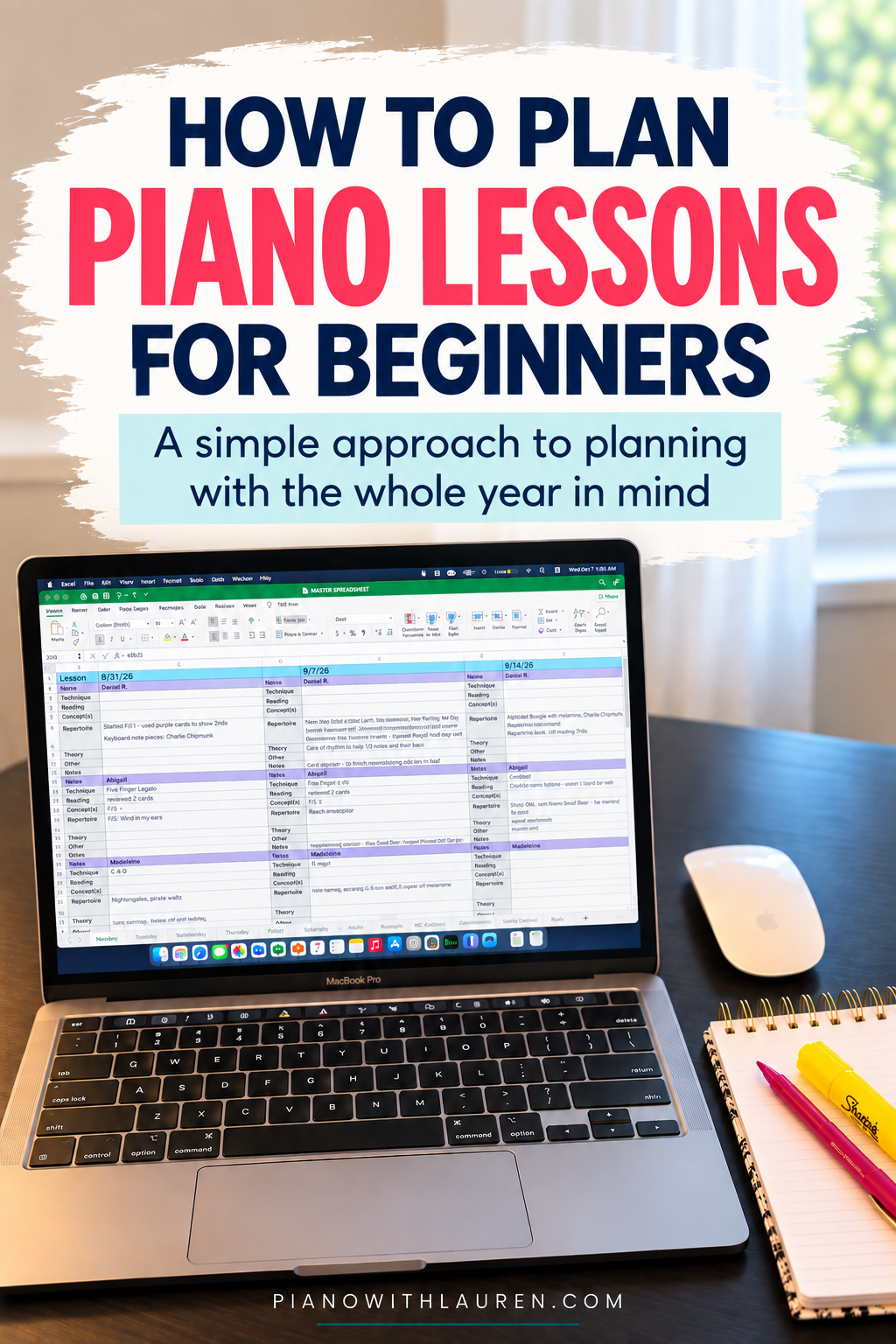
I also use a spreadsheet to keep track of what I’m working on with each student. It helps me see their current music, concepts, and activities in one place without creating a detailed lesson plan for every week. You can see how I organize my piano lesson planning spreadsheet here.
Think Beyond This Week’s Piano Lesson
Some of the best lesson planning happens long before the lesson begins. When you have an idea of the books you want to use, the skills you’re working toward, the performances coming up, and the activities you have available, weekly planning becomes much simpler.
You’re no longer asking yourself every week, What am I going to do with this student for 30 minutes? Instead, you’re deciding, What’s the best next step for this student? That’s a much easier question to answer.
As you get to know each student, your plan will continue to change. That’s part of good teaching. The goal isn’t to predict an entire year perfectly. It’s to have enough of a roadmap that you can make thoughtful decisions along the way.
Read More About Planning Beginner Piano Lessons
How to Plan a Piano Lesson for Beginner Students
How to Structure a 30-minute Piano Lesson
What Should You Teach in a Beginner Piano Lesson?
Ready to Put It All Together?
Most of my blog posts explore one teaching topic at a time. If you’re looking for a complete first-year teaching roadmap, my course, Beyond the Lesson Book, shows how these concepts fit together across an entire year of beginner piano lessons.
🎹 Explore Beyond the Lesson Book

Lauren teaches piano to students of all ages. She enjoys creating resources for her students and teachers. She is the author of Ready for Theory®. For personalized help, check out the consultations page for teachers.