This post may contain affiliate links. As a Sheet Music Plus and Amazon Associate, I earn from qualifying purchases. That means I make a small commission (at no additional cost to you) if you purchase something from an affiliate link.
One of the most common questions parents ask when their child starts piano lessons is, “How much should they practice?”
Should a beginner practice every day? Is 10 minutes enough? Does an older student need to practice for 30 minutes?
There isn’t one perfect amount of practice time for every piano student. A young beginner learning a few short pieces has very different practice needs from an older student working on longer, more challenging music.
In general, short, regular practice sessions are more valuable than occasional long ones. And while practice time can be a helpful guideline, what a student accomplishes during practice matters even more than the number of minutes they spend at the piano.
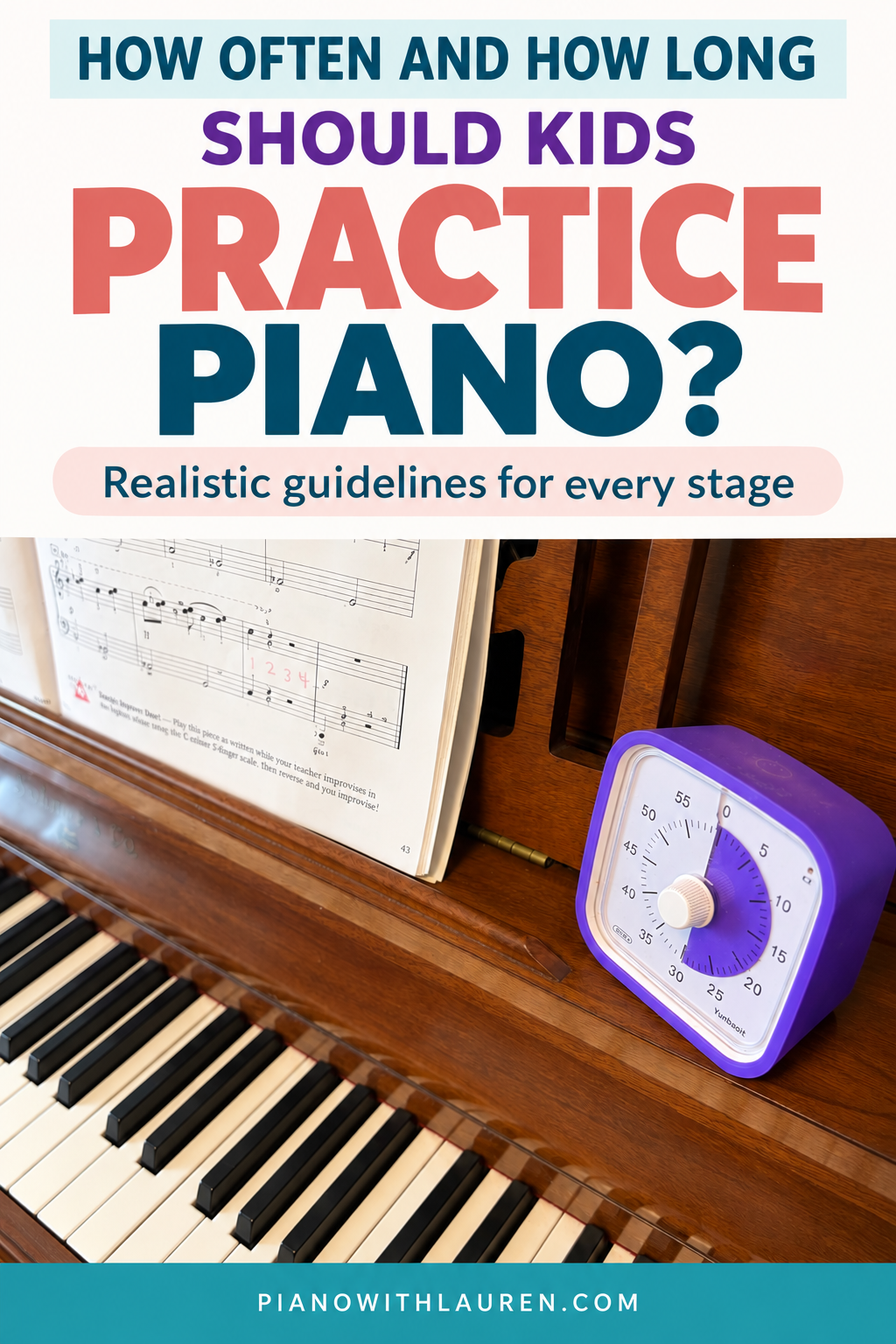
How Many Days a Week Should Kids Practice Piano?
For most piano students, I recommend practicing several days throughout the week rather than trying to fit all of their practice into one or two long sessions.
Practicing regularly helps students remember what they learned during their lesson and gives them repeated opportunities to work through new skills.
For many beginners, 4–5 days of practice each week is a reasonable goal.
That also leaves room for real life. Kids have homework, activities, family plans, and days when everyone is simply tired. Missing an occasional practice day isn’t going to derail a student’s progress.
What I try to avoid is the student who waits until the day before the lesson and then tries to squeeze an entire week’s worth of practice into one session. Learning an instrument works much better when practice is spread throughout the week.
How Long Should a Beginner Practice Piano?
For a young beginner, piano practice may only need to be 10–15 minutes at a time.
In the beginning, students usually have short pieces and a relatively small number of assignments. Ten focused minutes may be plenty of time to review a scale or technical exercise, work on a couple of pieces, and practice a specific skill from the lesson.
As students get older and their music becomes more challenging, practice sessions naturally become longer.
A general starting point might look something like this:
| Student | Approximate Practice Time |
|---|---|
| Young beginner | 5–10 minutes |
| Elementary-age beginner | 10–15 minutes |
| Advancing beginner | 15–20 minutes |
| Intermediate student | 20–30+ minutes |
These aren’t rules. They’re simply useful starting points.
One student may accomplish quite a bit in 12 focused minutes, while another may sit at the piano for 25 minutes without actually practicing very much.
Practice Quality Matters More Than Practice Time
This is why I don’t love using the clock as the main measure of a successful practice session.
Tell a child to practice for 20 minutes, and sometimes their main goal becomes making it to the end of those 20 minutes.
They play through a piece. They start over. They play through it again. They check the clock.
Technically, they’re practicing—but they may not be fixing anything.
Instead, I prefer giving students specific practice goals.
A practice assignment might include:
- Play a scale three times with the correct fingering.
- Practice measures 5–8 hands separately.
- Try that section hands together slowly.
- Fix the rhythm in two difficult measures.
- Add the dynamics to a piece.
- Play a finished piece from beginning to end.
When those goals are finished, the practice session has accomplished something—even if it didn’t last an exact number of minutes.
Is It Better to Practice Piano Every Day?
Practicing every day can certainly be helpful, but I don’t think families need to become overly rigid about it.
For most children, consistent practice throughout the week is more important than maintaining a perfect seven-day streak.
If your child practices five productive days and takes two days off, that’s still a very consistent practice routine.
There may also be weeks when practice looks different. A busy school week might mean several shorter sessions. During a quieter week, your child may spend more time at the piano.
The goal is to make piano practice a regular part of life without making the routine so demanding that it becomes difficult to maintain.
Should Kids Practice Longer Before Their Piano Lesson?
Trying to make up for missed practice with one long session the night before a lesson usually isn’t very effective.
Piano students need time between practice sessions for new skills to become more comfortable.
If a student learns a new section on Monday, returns to it on Tuesday, and works on it again on Thursday, they have several opportunities to remember what they learned and improve it.
That process is very different from trying to accomplish everything in one 45-minute session the night before the lesson.
If the week gets away from you, don’t worry about trying to “make up” all the missed minutes. A short, focused practice session is still worthwhile.
What If My Child Only Practices for Five Minutes?
Five minutes can actually be useful—especially for a young beginner.
If the alternative is skipping practice completely because there isn’t time for a full session, choose one small goal.
For example:
“Let’s practice those four measures your teacher circled.”
Or:
“Play your scale and work on your new piece once.”
A five-minute practice session won’t always be enough, but it keeps the student connected to the music and reinforces the habit of returning to the piano regularly.
And sometimes getting started is the hardest part. A child who agrees to practice for five minutes may decide to keep playing once they’re already at the piano.
Practice Time Should Grow With the Student
Parents sometimes assume that because 10 minutes was enough when their child started piano lessons, it should continue to be enough indefinitely.
But practice needs change as students progress.
Beginning pieces may only be a page long. Later, students are juggling longer repertoire, scales, technique, sight-reading, theory, and more detailed musical goals.
As the assignments become more substantial, practice time should gradually increase too.
You don’t necessarily need to announce, “You’re older now, so you have to practice for 30 minutes.”
Often the change happens naturally because the student simply has more meaningful work to accomplish.
Watch the Student, Not Just the Clock
Practice recommendations are helpful, but the better question is:
Is this amount of practice allowing the student to make steady progress?
If your child regularly finishes assignments, improves between lessons, and is able to move forward with new material, their current routine may be working just fine.
If they’re consistently arriving at lessons with pieces that haven’t improved, forgetting skills from the previous week, or struggling to complete assignments, they may need either more frequent practice or more focused practice.
Sometimes the solution isn’t more minutes. The student may simply need clearer instructions about how to practice.
A Simple Goal for Piano Practice
For most young piano students, I would start with a very simple goal:
Practice for a short amount of time, several days throughout the week, with something specific to accomplish each time.
For a young beginner, that might mean 10 minutes on four or five days each week.
As the student progresses, both the length and complexity of practice will naturally grow.
Rather than worrying about whether your child practiced the “right” number of minutes, pay attention to whether they’re developing a consistent habit and learning how to use their practice time well.
Ultimately, that’s much more valuable than simply watching the clock.
More Help With Piano Practice
Building good practice habits takes time. These articles can help you create a routine that works for your child and gradually encourage more independent practice.
- Piano Practice for Kids: A Guide for Parents and Teachers
- How to Create a Piano Practice Routine That Works
- How to Get Your Child to Practice Without a Battle
- How Often and How Long Should Kids Practice Piano?
- Should Parents Sit With Their Child During Piano Practice?
- How Parents Can Help With Piano Practice—Even If They Don’t Play Piano
Ready to Put It All Together?
Most of my blog posts explore one teaching topic at a time. If you’re looking for a complete first-year teaching roadmap, my course, Beyond the Lesson Book, shows how these concepts fit together across an entire year of beginner piano lessons.
🎹 Explore Beyond the Lesson Book

Lauren teaches piano to students of all ages. She enjoys creating resources for her students and teachers. She is the author of Ready for Theory®. For personalized help, check out the consultations page for teachers.