When most people think about beginner piano lessons, they think about learning notes, finger numbers, and finding keys on the keyboard. While those skills are important, young piano students should also begin developing their listening skills from the very first lesson.
For 4–5 year olds, ear training doesn’t mean identifying complex chords or intervals. Instead, it means learning to hear simple musical differences and respond to them. These listening skills help students become more musical, improve concentration, and build a strong foundation for future piano study.
This post may contain affiliate links. As a Sheet Music Plus and Amazon Associate, I earn from qualifying purchases. That means I make a small commission (at no additional cost to you) if you purchase something from an affiliate link.
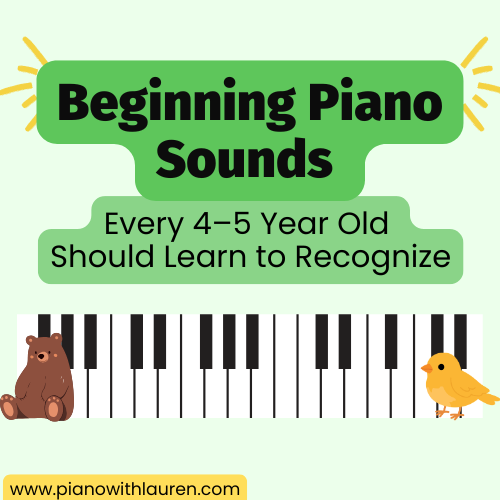
Below are six different sounds every young beginner should learn to recognize.
1. High Sounds and Low Sounds
One of the easiest concepts for young children to understand is the difference between high and low sounds.
At the piano:
- High sounds are found on the right side of the keyboard.
- Low sounds are found on the left side of the keyboard.
Try asking students:
- “Does this sound like a bird or a bear?”
- “Is this sound high or low?”
- “Can you find another high sound?”
These simple listening activities help students connect sound with keyboard geography.
2. Loud and Soft Sounds
Music isn’t always played at the same volume.
Young students can begin recognizing:
- Loud sounds
- Soft sounds
Play a note or short pattern and ask:
- “Was that loud or soft?”
- “Can you play it louder?”
- “Can you make it whisper?”
Children love exaggerating dynamics, making this one of the easiest concepts to teach.
3. Fast and Slow Sounds
Tempo describes how fast or slow music moves.
Young beginners can practice identifying:
- Fast sounds
- Slow sounds
Try:
- Marching to a steady beat
- Walking slowly like a turtle
- Moving quickly like a bunny
Then transfer the activity to the piano by playing short patterns at different speeds.
4. Same and Different Sounds
Listening for similarities and differences helps students develop concentration.
Play:
- The same note twice
- Two different notes
Ask:
- “Were those the same or different?”
As students improve, try simple note patterns.
This game helps develop careful listening and prepares students for more advanced ear training later.
5. Sounds Going Up and Down
Students should begin hearing whether music moves:
- Up
- Down
Play a short pattern moving upward on the keyboard.
Ask:
- “Did the sounds go up or down?”
To help students understand going up, make sure they understand that the sounds get higher as notes move “up.”
This concept also prepares students for reading melodic direction in music.
6. Long Sounds and Short Sounds
Young beginners can start recognizing note lengths before they fully understand rhythm notation.
Play:
- A long sound
- A short sound
Ask:
- “Which note lasted longer?”
You can connect this concept to quarter notes, half notes, and whole notes later.
You can read more about teaching beginning rhythms to preschoolers here.
Developing a strong sense of pulse makes future rhythm learning much easier.
🎲 Fun Listening Games
No supplies are needed for the following ear training games.
🐻 Bird or Bear?
Play a note.
Students decide:
- Bird = high sound
- Bear = low sound
🚦 Stop and Go
Play music.
- Fast = run in place
- Slow = walk
- Stop = freeze
👍 Same or Different?
Play two notes.
Students give a thumbs up for same and a thumbs down for different.
🎵 Up or Down?
Play a short pattern.
Students point their finger up or down to match what they hear.
Tips for Success
- Keep activities under two minutes.
- Use movement whenever possible.
- Encourage listening before explaining.
- Make games playful and interactive.
- Celebrate correct listening, not perfect answers.
The Big Picture
Listening is one of the most important musical skills a child can develop. By learning to recognize high and low sounds, loud and soft dynamics, fast and slow tempos, and simple melodic patterns, young beginners start building the foundation for a lifetime of music-making.
👉 Looking for a complete roadmap of beginner piano concepts?
Be sure to read: Piano Lessons for 4–5 Year Olds: What Beginners Need to Learn
Related Young Beginner Piano Topics
- Musical Alphabet Games for Piano Students
- Teaching Hands and Finger Numbers in Piano Lessons
- How to Teach Piano Black Keys and White Keys
- Decorate the Piano: A Fun Piano Key Activity
- Teaching Rhythm to Preschool Piano Students

Lauren teaches piano to students of all ages. She enjoys creating resources for her students and teachers. She is the author of Ready for Theory®. For personalized help, check out the consultations page for teachers.