Teaching rhythm to preschool piano students should feel playful, active, and creative. At ages 4–5, children learn best through movement, listening, repetition, and hands-on activities rather than long explanations. When introducing rhythm, the goal is to help children feel the beat.
By introducing quarter notes, half notes, whole notes, and simple rests through games and movement, young beginners can build a strong musical foundation while having fun at the piano.
This post may contain affiliate links. As a Sheet Music Plus and Amazon Associate, I earn from qualifying purchases. That means I make a small commission (at no additional cost to you) if you purchase something from an affiliate link.
Start with the Steady Beat
Before introducing rhythm symbols, help children experience a steady beat physically.
Try:
- – Clapping along to music
- – Marching around the room
- – Tapping knees
- – Playing drums or rhythm sticks
- – Walking to the beat
Use simple phrases like:
- “Keep the beat going!”
- “Can you march with the music?”
- “Let’s clap together!”
Once students can follow a steady beat consistently, they are ready to connect beat with rhythm patterns.
Introducing Basic Rhythm Notes
Keep explanations short, visual, and interactive. When teaching the various notes and rests values, spread out the concepts so that they are not taught all at once. For example, in one lesson you can cover just quarter and half notes. When the student is confident with these, you can add in whole notes at a different time.
Quarter Note
Quarter Note=1 beat
A quarter note gets one beat.
Practice by:
- Clapping once per note
- Marching one step per beat
- Saying one-syllable words like: “ta” or “walk”
To count:
Starting with numeric counting can be confusing at this age. While you can use some numeric counting to help students (some are suggested below), I recommend using syllabic counting. Use words such “ta” for quarter notes and “ta-2” for half notes.
Half Note
Half Note=2 beats
A half note lasts for two beats.
Practice by:
- Clapping once on “half” then holding hands together when saying “note.”
- Freezing like a statue for two beats
- Clap on “one” and hold hands together and say “two”
- Hold the piano key down for two counts.
Options to count:
- “1–2”
- “half note”
“ta-2”
Whole Note
Whole Note=4 beats
A whole note lasts for four beats.
Practice by:
- Clap on “one” then hold all the way to four while saying “two, three, four.”
- Play the piano key and hold it for four counts
Count:
- “ta–2–3–4”
- “Hold that Whole Note”
Teaching Rests
Young children often think music always means making sound, so rests can feel tricky at first. Making silence playful helps children understand that rests are part of music too.
Quarter Rest
Quarter Rest=1 beat of silence
Practice by:
- Saying “shh!” when shown a quarter rest
- Play a key on the piano then say “shh” to feel the rest
Teach it as:
- “Shh!”
- “Rest!”
Half Rest
Half Rest=2 beats of silence
Practice by:
- Saying “shh!” two times
- Whisper “half rest” to make it feel like two beats
Count it as:
- “Half rest”
- “shh! shh!”
Activities to Teach Rhythm
🃏 Rhythm Cards
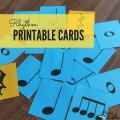
One of the best ways to teach rhythm to preschoolers is to let them become the “composer.” Young children love making choices, and rhythm cards turn learning into a creative game.
How to Play
Prepare rhythm cards using:
- Quarter notes
- Half notes
- Whole notes
- Quarter rests
- Half rests
Start with only a few rhythm types at first so students do not feel overwhelmed.
Invite the student to:
- Choose rhythm cards
- Arrange them in a pattern
- Clap the rhythm
- Play it on one piano key
- March or tap along
Teacher/Parent Tip
Keep rhythms short:
- 2–4 beats is ideal for this age group
Simple patterns help young students feel successful and confident.
🪇 Instrument Rhythm Echo Game
Echo games are excellent for building listening skills, rhythm memory, and steady beat. Adding instruments makes the activity even more exciting for preschool students.
How to Play
Choose simple percussion instruments such as:
- Rhythm sticks
- Drums
- Bells
- Shakers
- Tambourines
The teacher plays a short rhythm pattern.
The student echoes it back exactly.
Start with simple patterns:
- Quarter notes only
- Then add half notes
- Then add rests
Examples:
- Tap tap tap
- Tap hold
- Tap rest tap
Keep It Playful – Switch Roles
Once students feel confident, let them become the teacher.
Children love creating rhythms for adults to copy, and this builds:
- Rhythm recognition
- Confidence
- Listening skills
- Creativity
🃏🪇 Combine Both Games Together
A favorite preschool piano activity is combining rhythm cards with instruments.
Students:
- Build a rhythm pattern with cards
- Clap the rhythm
- Play it on instruments
- Echo it back and forth with the teacher
This creates multiple layers of learning while still feeling like play.
🎲 Use a Workbook for Reinforcement
Activity pages and games are a great way to supplement lessons. When little ones need a break from sitting at the piano, it’s a great time to pull out a short activity. The rhythms in this post are covered in My First Piano Workbook. I designed the workbook to be mostly coloring and drawing, which is perfect for ages 4-5. The pages are full of fun images to engage young minds.
How to Use the Workbook in Lessons
For preschool students, workbook time should stay short and interactive.
Try using workbook pages:
- At the beginning of lessons as a warm-up
- In the middle of lessons for a quieter activity
- At the end of lessons as a fun review
Most 4–5 year olds do best with:
- One page or less per lesson
- Plenty of teacher guidance
- Lots of praise and encouragement (This is built into the workbook also.)
Why Rhythm Games Work So Well for Preschoolers
At ages 4–5, children learn music best through:
- Movement
- Listening
- Repetition
- Creativity
- Pretend play
Games using rhythm cards and instruments allow children to experience rhythm physically before they are expected to read notation fluently.
That playful foundation makes future rhythm reading much easier and more natural.
Final Thoughts
Teaching rhythm to 4–5 year old piano students should feel joyful, interactive, and imaginative. When lessons include movement, rhythm cards, instruments, and creative games, children naturally absorb musical concepts while having fun.
The most important goal at this age is helping children develop confidence and excitement about music. A child who enjoys rhythm activities today is much more likely to become a confident young musician tomorrow.
👉 Looking for a full roadmap of what to teach beginners?
Check out: Piano Lessons for 4–5 Year Olds: What Beginners Should Learn First
❓ Wondering what piano to get for your beginner?
Check out this comprehensive post on various keyboard and piano options based on how much you want to spend in addition to your intentions for lessons: The Best Keyboards for Starting Piano Lessons
Related Young Beginner Piano Topics
- Musical Alphabet Games for Piano Students
- Teaching Hands and Finger Numbers in Piano Lessons
- How to Teach Piano Black Keys and White Keys
- Decorate the Piano: A Fun Piano Key Activity
- Beginning Piano Sounds Every 4-5 Year Old Should Learn to Recognize

Lauren teaches piano to students of all ages. She enjoys creating resources for her students and teachers. She is the author of Ready for Theory®. For personalized help, check out the consultations page for teachers.