One of the very first skills young piano students need to learn is understanding their right hand, left hand, and finger numbers. Before students can comfortably play songs at the piano, they need to know which hand to use and which finger should play each note.
For children ages 4–5, these concepts should be taught through movement, games, and repetition. At this age, learning happens best when it feels playful and interactive.
Here are some simple ways to teach hands and finger numbers in beginner piano lessons.
This post may contain affiliate links. As a Sheet Music Plus and Amazon Associate, I earn from qualifying purchases. That means I make a small commission (at no additional cost to you) if you purchase something from an affiliate link.
Learning Right Hand and Left Hand
Young beginners often mix up right and left, so it’s important to reinforce this concept regularly during lessons.
Start away from the piano with simple movements like:
- “Raise your right hand”
- “Tap your left knee”
- “Wave with your right hand”
- “Hide your left hand behind your back”
The more students move and interact, the faster they begin to remember the difference between their hands.
Connecting Hands to the Piano
Once students are comfortable identifying right and left, connect the idea to the keyboard.
Try activities like:
- Play high sounds with the right hand
- Play low sounds with the left hand
- Tap the piano lid with the correct hand
- Play groups of two black keys with the right hand and groups of three black keys with the left hand
These activities help students associate each hand with movement and sound at the piano.
Introducing Finger Numbers
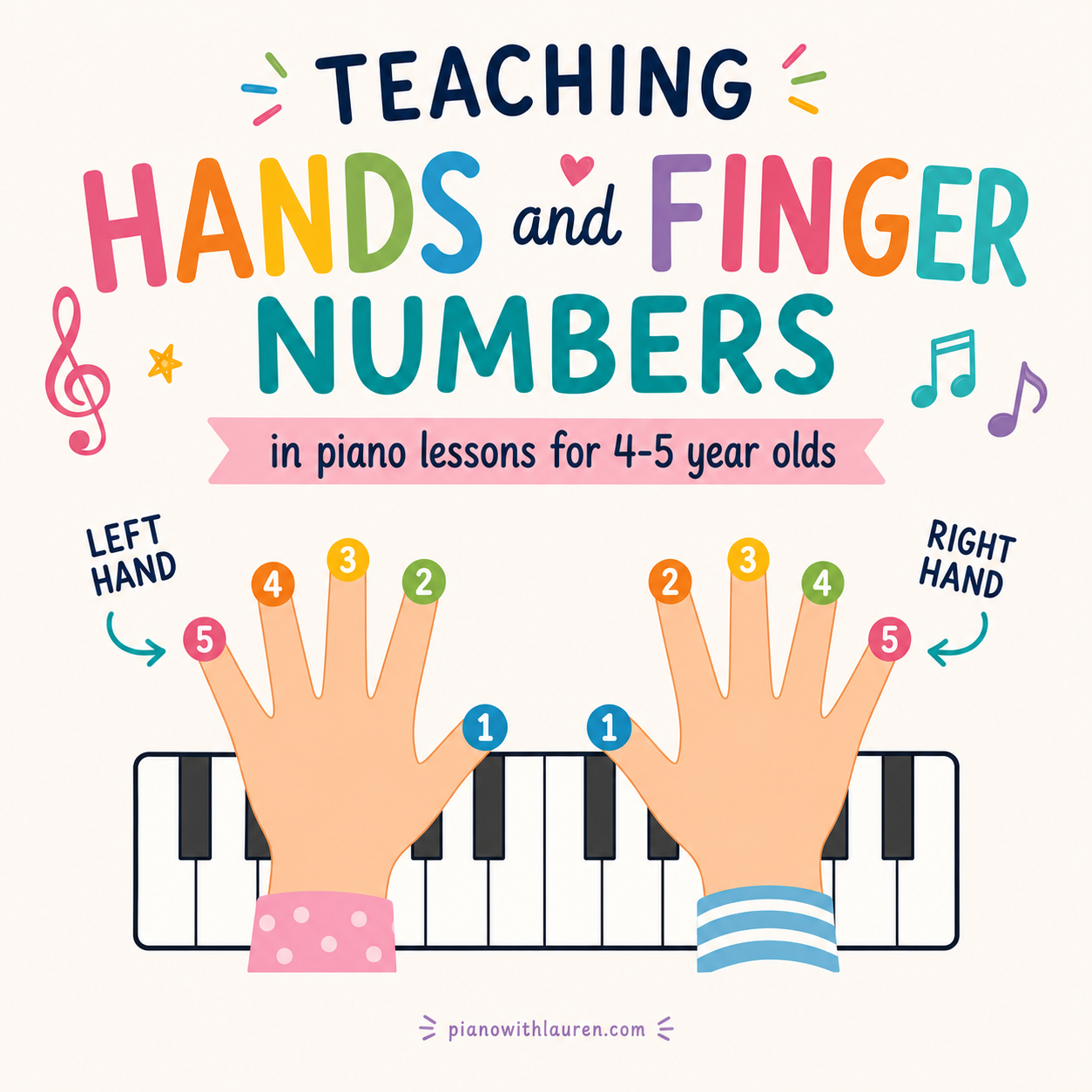
Instead of finger names, piano students use numbers for each finger.
Both hands use the same numbers:
- Thumb = 1
- Pointer finger = 2
- Middle finger = 3
- Ring finger = 4
- Pinky finger = 5
Finger numbers are an important part of piano playing and will continue to appear in music as students advance.
🎲 Finger Number Games for Young Beginners
Teaching finger numbers through games helps students memorize them naturally.
Trace Your Hand
Have students trace one of their hands on paper.
Then:
- Write finger numbers on each finger
- Color or decorate the hand
This creates a visual connection between fingers and numbers.
Finger Number Call-Outs
Ask the student to hold out one hand.
Call out a number:
- “Touch finger number 3!”
- “Wiggle finger number 5!”
You can make this even more fun by increasing speed or turning it into a challenge.
Finger Taps
Tapping certain finger numbers helps start the coordination of playing a particular finger on the piano. Have students tap finger numbers on:
- The piano fallboard
- Their lap
- A tabletop
For example:
- “Tap 1-2-3”
- “Tap 5-4-3-2-1”
This builds coordination while reinforcing finger numbers.
👉 Take it further: Write out finger numbers on a white board for the student to tap. Then have the student do the same for you. Students love when they get to be the teacher!
Why Hands and Finger Numbers Matter
Understanding right and left hand is essential for:
- Following directions in lessons
- Reading beginner music
- Developing coordination
- Playing with confidence
Learning finger numbers early also makes it easier for students to:
- Follow finger patterns
- Transition into reading music
- Develop proper piano technique
These small foundational skills make a huge difference as students progress.
💡 Tips for Teaching Hands and Finger Numbers
- Keep activities short and active
Young students learn best in small bursts of focused play. Aim for quick 1–2 minute activities throughout the lesson. - Use movement as much as possible
Standing up, tapping, clapping, and moving around the room helps children remember concepts faster than sitting still. - Repeat the same games often
Repetition builds confidence. Young beginners enjoy familiar activities, especially when they feel successful. - Pair visuals with learning
Use hand drawings, colorful finger numbers, stickers, or finger puppets to make learning more memorable. - Celebrate effort, not perfection
Right and left can be confusing at this age. Encourage students when they try, even if they mix things up sometimes. - Connect concepts back to the piano
After practicing away from the keyboard, immediately apply the skill at the piano so students make the connection.
🎁 Helpful Tools for Teaching Hands and Finger Numbers
Teaching right and left hand along with finger numbers becomes much easier when students can see, touch, and play with the concepts. Here are a few beginner-friendly tools that make learning more engaging for young piano students.
Free Printable Finger Number Activities
Looking for an easy way to practice finger numbers with young beginners?
A free printable finger number activity is a great way add another hands-on, fun activity for students. Check out the free Piano Finger Bling worksheets on Color My Piano.
My First Piano Workbook
If your student enjoys hands-on activities, My First Piano Workbook is a great next step for reinforcing beginner piano skills at home or during lessons.
Designed especially for ages 4–6, the workbook includes activities for:
- Right hand and left hand recognition
- Finger numbers (1–5)
- Piano key identification
- Early music concepts and games
With coloring pages, tracing activities, and playful exercises, students stay engaged while building confidence at the piano.
👉 Take a look inside the workbook here.
Beginner Piano Method Books
A strong beginner method book can help students continue building finger coordination and hand awareness in a structured way.
One of my favorite series for young beginners is My First Piano Adventure because it combines movement, listening, and age-appropriate activities designed specifically for ages 4–6.
👉 See the beginner method book here.
Rhythm & Movement Tools
Simple rhythm instruments and movement activities can also strengthen coordination and finger control.
Helpful beginner tools include:
These small additions make lessons feel playful while reinforcing important piano skills.
🌟 Make Learning Fun
For 4–5 year old beginners, learning piano should feel playful and encouraging. Teaching right and left hand awareness along with finger numbers gives students an important foundation for everything they will learn later.
By combining movement, games, and simple piano activities, young students begin developing coordination, confidence, and independence at the keyboard.
These early lessons may seem simple, but they are some of the most important building blocks in a child’s musical journey.
👉 Looking for more beginner piano ideas?
Check out: Piano Lessons for 4–5 Year Olds: What Beginners Need to Learn
Related Young Beginner Piano Topics
- Musical Alphabet Games for Piano Students
- How to Teach Piano Black Keys and White Keys
- Decorate the Piano: A Fun Piano Key Activity
- Teaching Rhythm to Preschool Piano Students
- Beginning Piano Sounds Every 4-5 Year Old Should Learn to Recognize

Lauren teaches piano to students of all ages. She enjoys creating resources for her students and teachers. She is the author of Ready for Theory®. For personalized help, check out the consultations page for teachers.