One of the very first skills young piano beginners need to learn is how to recognize the groups of black keys and white keys on the piano. For children ages 4–5, this step builds confidence and helps them feel comfortable exploring the keyboard before they begin reading notes.
The good news is that preschoolers learn best through patterns, games, and repetition. Since the piano keyboard is built on repeating patterns, it becomes much easier for young children to understand once they notice the groups of two and three black keys.
This post may contain affiliate links. As a Sheet Music Plus and Amazon Associate, I earn from qualifying purchases. That means I make a small commission (at no additional cost to you) if you purchase something from an affiliate link.
➡ Start with the Black Key Groups
The easiest place to begin is with the black keys because they form clear visual patterns.
On every piano keyboard, the black keys repeat in groups of:
- Two black keys
- Three black keys
Show your student how these patterns repeat all the way across the piano. Encourage them to point to:
- A group of two black keys
- A group of three black keys
Young children enjoy pattern recognition, so this activity often feels like a game rather than a lesson.
🎲 Turn It Into a Game
Preschoolers learn best when lessons are playful. Try simple activities like:
- Play every set of two black keys.
- Play every set of three black keys.
- Incorporate high & low into the activity by asking the student to play a low set of three black keys.
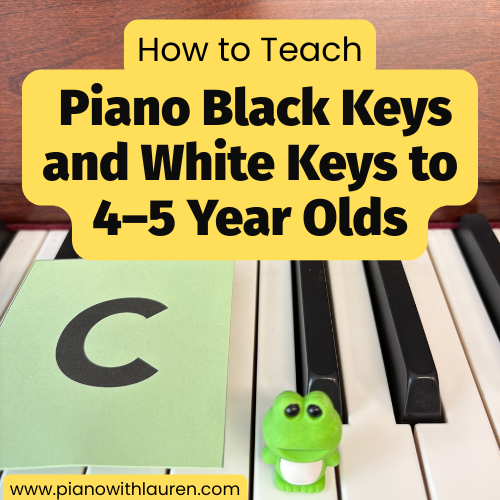
- Use a fun object like a pom pom or animal eraser and ask the student to place it on every set of two black keys.
- Use a longer item like a pipe cleaner and ask the student place it on every set of three black keys.
These games help children become familiar with the keyboard layout while improving listening and coordination skills.
🎹 Introduce the White Keys
Once children can confidently spot the black key groups, it becomes easier to teach the white keys.
Explain that the white keys are named using letters from A to G.
Instead of teaching all the letter names at once, begin with just two important notes:
- C
- F
These are easy to find because they are connected to the black key groups.
How to Find C
Show your student that C is the white key directly to the left of every group of two black keys.
You can say:
“Two black keys help us find C.”
Have them search for every C on the keyboard and play each one.
How to Find F
Next, explain that F is the white key directly to the left of every group of three black keys.
You can say:
“Three black keys help us find F.”
Again, let them find and play every F on the piano.
Moving On
Once students can easily identify the C & F keys, you can move onto learning the other keys by the two-black keys (C, D, & E) and then the keys by the three-black keys (F, G, A, and B).
🎲 Turn It Into a Game
At ages 4–5, children remember concepts better when they play and repeat activities often.
To make it more playful, try these activities:
- Choose an alphabet card, and ask the student to find and play every key of that letter.
- Choose a letter. Ask the student to place a fun object like small alphabet cards or an animal eraser on every key of that letter.
- Play a key and ask the student to name it out loud.
- Let the student be the “teacher.” Tell them to play any key and you’ll be the one to name it. They can let you know if you are right or wrong.
- Use fun coloring activities such as pages from My First Piano Workbook to reinforce these topics.
Keep Lessons Simple
Short, playful lessons are usually more effective than long explanations. Young beginners do not need to memorize every piano note immediately. The goal at this stage is simply to help them:
- Recognize keyboard patterns
- Feel comfortable at the piano
- Develop finger coordination
- Build excitement about learning music
Once children can easily identify black key groups and locate a few white keys, they are ready to move on to simple songs and beginner piano activities.
Final Thoughts
Learning the groups of black keys and white keys is one of the most important first steps for beginner piano students ages 4–5. By using games, repetition, and visual patterns, children can quickly become confident navigating the keyboard.
When lessons stay playful and encouraging, young beginners build a strong musical foundation that makes future piano learning much easier and more enjoyable.
👉 Looking for more beginner piano ideas?
Check out: Piano Lessons for 4–5 Year Olds: What Beginners Need to Learn
🎲 For a more in-depth activity for learning the keyboard geography (without stickers!) check out my Decorate the Piano post.
❓ Wondering what piano to get for your beginner?
Check out this comprehensive post on various keyboard and piano options based on how much you want to spend in addition to your intentions for lessons: The Best Keyboards for Starting Piano Lessons
Related Young Beginner Piano Topics
- Musical Alphabet Games for Piano Students
- Teaching Hands and Finger Numbers in Piano Lessons
- Decorate the Piano: A Fun Piano Key Activity
- Teaching Rhythm to Preschool Piano Students
- Beginning Piano Sounds Every 4-5 Year Old Should Learn to Recognize

Lauren teaches piano to students of all ages. She enjoys creating resources for her students and teachers. She is the author of Ready for Theory®. For personalized help, check out the consultations page for teachers.